FAO Quotables

"But being right, even morally right, isn't everything. It is also important to be competent, to be consistent, and to be knowledgeable. It's important for your soldiers and diplomats to speak the language of the people you want to influence. It's important to understand the ethnic and tribal divisions of the place you hope to assist."
-Anne Applebaum

Wednesday, June 15, 2011

China in Africa Real Story Blog takes on Johnnie Carson and Sec Clinton


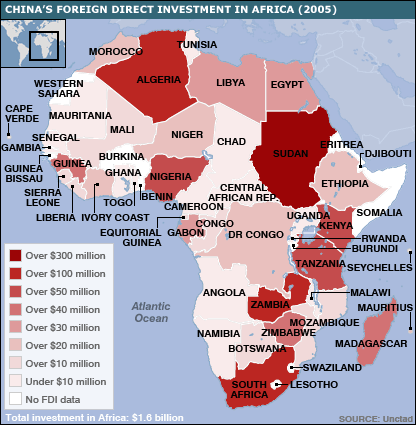
I have written about Professor Brautigam's excellent blog numerous times (China in Africa: The Real Story).  If you want to learn the real deal on what China is doing in Africa, read everything that you can get your hands on by her and Ambassador David Shinn (http://davidshinn.blogspot.com/).  Her latest posts makes some excellent points.  You can click on this post's title to read her entire post but following is the most important paragraph:

"China has a long way to go in improving its multi-faceted engagement on the continent, but the US is not there yet either. The difference is not as complete as Secretary Clinton would have us think. Pointing to the principles that do generally guide our aid, ignoring US companies happily investing with a pat on the back from the Obama administration in places like Equatorial Guinea, and then comparing our aid to Chinese aid and investment is a common debate tactic among op-ed critics (Michael Gerson did this recently in the Washington Post). I would have hoped that Secretary Clinton would do better than this. But perhaps as her major advisor on Africa (and, probably, on China's role there) is Ambassador Johnnie Carson, the person who, in the Wikileaks cables, famously dismissed China in Africa as "a pernicious economic competitor ...[with] no morals", it's not a surprise. "
Those of you who read this blog regularly know that I 'heart' Ambassador Carson, but I would tend to agree with Brautigam in this case.  HOWEVER I would add that I am sure Carson's view is slightly more nuanced than the Wikileaks cable makes it out to be. 


Tuesday, June 14, 2011

State Department Briefing on Sudan

I love getting these State Department transcripts delivered to my inbox.  They are a great way to stay current on the myriad issues that are constantly percolating on the continent, and they are great to file away when you need to work up a background/issue paper.  As someone who doesn't know much on Sudan, I found it very helpful. 

Additionally, CFR has a great interactive crisis guide that takes you through the history of the conflict in Darfur in about an hour (they have them on a variety of other topics as well):

http://www.cfr.org/sudan/crisis-guide-darfur/p13129


Africa: Background Briefing En Route to Washington, D.C. <http://www.state.gov/r/pa/prs/ps/2011/06/166081.htm
Tue, 14 Jun 2011 05:51:04 -0500

Special Briefing
Senior State Department Official
Senior Official
En Route to Washington, DC

June 13, 2011

________________________________


MODERATOR: We have this evening a Senior State Department Official to discuss the Secretary’s meetings today with Prime Minister Meles and the meetings with representatives from North and South Sudan.

SENIOR STATE DEPARTMENT OFFICIAL: The Secretary came at a time when there were very high-level negotiations going on in Addis Ababa between North and South Sudan organized by –

MODERATOR: Hold on a sec; they can’t hear.

SENIOR STATE DEPARTMENT OFFICIAL: -- organized by the Africa Union High-Level Panel. That’s the panel in charge of negotiations headed by former South African President Thabo Mbeki, but also hosted by Ethiopia’s Prime Minister Meles Zenawi. And the reason for this summit was because, as I think you all know, recently the –

MODERATOR: (Inaudible.)

SENIOR STATE DEPARTMENT OFFICIAL: As you know, recently the Government of Sudan’s armed forces took over the contested region of Abyei and drove out not only the forces of South Sudan, but also the Ngok Dinka clan, and we have now close to 100,000 displaced from Abyei. That caused a crisis in itself, but very shortly afterwards, the government was sending forces down into the state of South Kordofan. South Kordofan had just had an election in which the governor was reelected, but the other candidate who represents the SPLA – SPLM North – and I’ll get back to that in a minute – did not recognize the results of the election.

So there was already a great deal of tension there, and the government troops said that they were there to disarm the SPLA troops who were in South Kordofan. You have to know that the troops in South Kordofan and Blue Nile are SPLA troops, but they’re not Southerners. They are indigenous to the Nuba Mountain area of South Kodofan and Blue Nile, but they fought with the SPLA in the civil war. But they’re Northerners.

Well, the idea that they might be forcibly disarmed has set off what has become a very, very serious armed conflict going on in South Kordofan state. Bombing has occurred, a lot of displacement – we now think up to 40,000 displaced – a shortage of food and water in many places, quite a bit of fighting from both sides.

Now, this summit was an attempt to bring this whole – both these situations back under control. On the Abyei side, the discussion was to get the Government of Sudan to withdraw from Abyei. To do that, one had to enhance the UN force that had been in Abyei. It was not effective up till now in keeping each side from introducing forces that were not by agreement to be there.

To enhance that, Ethiopia offered to provide troops, two or three battalions, but only on the condition that both President Bashir and Vice President – but President of the South – Salva Kiir – both requested it. He wasn’t going to go into that hot spot unless both sides wanted him to do so. And that has off a very complicated negotiation because the Government of Sudan in Khartoum says, well, I want to know what they’re going to do because I don’t like the way the UN has performed in the past. So that’s an awful long discussion.

In the meetings that were taking place when the Secretary arrived, they had not reached agreement. They were disagreeing over two things: the exact mandate under which the Ethiopian troops would operate, but also the Government of Sudan would say we also want to know what kind of administration of Abyei will take place when we withdraw because we didn’t like the last administration, we thought it was biased, and we want a new one that’s 50/50 between the Ngok Dinka and the Miseriya.

The SPLM said no, no, that’s not the way it works. Ngok Dinka – this is the land of the Ngok Dinka, the Miseriya are largely nomadic groups, we don’t see it 50/50. And that’s where the talks are deadlocked right now. Although President Bashir went back today to Khartoum, the two sides continue tomorrow to talk.

Now, in South Kordofan, fighting still goes on, and it’s very serious situation. The Secretary, arriving on her trip to Addis, met with Prime Minister Meles and had a briefing from him on the talks and the issues thereby. She then met with both – each side individually. She met with a special presidential advisor Nafie Ali Nafie accompanied by Sayed – and I can’t think of his last name, I apologize, but he’s an important figure in their North-South negotiations – and urged them very strongly to reach agreement on the security arrangements that would permit a withdrawal and said the U.S. would support the right kind of an agreement and urged them not get hung up, basically, on the administration issue, to get that resolved. And I think it was an important meeting.

Now, these were short meetings because, as you all know, we are running away from an ash cloud. So they weren’t as long as they had originally been scheduled, so we didn’t into a lot of bilateral issues and other things like that.

She then met with Salva Kiir, who, as you know, is the first vice president of the Government of National Unity but also the Government of South Sudan. And he was accompanied by his foreign minister, Deng Alor – he’s actually called minister of regional cooperation – and a lot of other people. And she again made this strong pitch to reach agreement on security arrangements for Abyei and a very strong (inaudible) pitch on cessation of hostilities in South Kordofan. And they voiced their opinion.


Basically, the two sides – I mean it’s a wonderful (inaudible) kind of situation. If you listen to one side, the other side violated all the protocols and they had instigated the violence. And then you listen to the other side, and it’s no, the other guys violated all the protocols and instigated the violence. And what it goes to is that these are two entities that really don’t trust each other. Each one thinks the other is conspiring against him. And because of that, on any issue of which is vital to them, whether it’s Abyei, which is emotionally important to both sides, or South Kordofan, which is a very complex situation, it’s easy when you’re thinking the other guy is always plotting against you to move either militarily or some other way.

So this negotiation really is very important; it isn’t over yet. To try and get the sides to sit down and say, okay, let’s pull back from these kind of military confrontations and get back to negotiating, we’re less than a month away from the South’s independence. The Secretary, I think, came at a very important time to indicate how important this was to the United States, how much we would lend support to any agreement they reach, and that we supported the CPA, the Comprehensive Peace Agreement, and the idea of it of coming out with two viable states at the end of it.

QUESTION: Do you want to say a word about what’s to be gained if we can get peace and what’s to be lost if we can’t?

SENIOR STATE DEPARTMENT OFFICIAL: Yeah. I mean, for the two sides, these are two sides that don’t like each other, don’t trust each other, but have to live together. You know what people say: You can’t choose your neighbors. And they are so intertwined economically that they can hurt each other and hurt themselves very badly, whether it’s in oil or new currencies or trade on the border or whatever issues they have.

And so they risked by this outbreak of violence a peaceful separation of the South, one in which they’ve come to an agreement on oil wealth transfers, on border monitoring, on Abyei and other things. So they get off to a good start on cooperation. It is – it cast a pall over the negotiation of all these other issues.

For the North, for Sudan, as it will be after July 9th, they were on a path with the CPA and hopefully peace in Darfur to get back into good graces of the international community. They’re carrying a $38 billion debt, they’re going to lose 60 to 70 percent of their revenue from oil, they have major economic adjustments to make, so getting into debt relief, access to the World Bank, all those things, are there if they move through the CPA and things get better in Darfur. If you get into a military situation, if they violate UN Security Council resolutions for them to withdraw, let’s say, from Abyei, if they look like it’s more confrontational than negotiations, those processes can’t go on. It’s not just the United States; the Europeans have the same policies.

So the consequences for the North are very grave if they’re thinking two, three years ahead. If they’re thinking tomorrow, how do I get one up on the other side, that’s a different story. But if you look at it --

QUESTION: Is there any danger of the independence being delayed or anything?

SENIOR STATE DEPARTMENT OFFICIAL: Well, the South’s going to be independent on July 9th and the South takes the position we’re not going to respond – the South Kordofan, it’s a little different – we’re not going to respond to the takeover of Abyei, we’re not going to be lured into major military confrontation, because we want our independence on July 9th and we’re not going to let anything interfere with it. And I think that’s a foregone conclusion.

QUESTION: Did the North do this in a way as a bargaining chip, and is it the way theynegotiate? I mean, they used a pretext to get in there and try ahead of July 9th deadline to cut themselves a better deal.

SENIOR STATE DEPARTMENT OFFICIAL: That’s one theory. The other is – and there’s some truth to it as well – that after July 9th a lot of people in the government in Khartoum and elsewhere said, hey, we didn’t get anything for this, we thought the world would be at our doorstep. The Americans promised us things, but they all come after July. And we’re not getting anything and the South is not treating us well and they’re making a hard time in negotiations. And it built up what I called a sourness in the mood starting in March and April, and it made the military feel that they too were getting – they had to sit and watch the SPLA put people into Abyei and there were clashes. And so I think it also built up a sense of this frustration – we got to hit back because we’re not getting much out of this. So yes, some people think it’s a kind of a premeditated negotiating strategy, but I think it was also in the context – not necessarily justified – of hey, why did we do this, a buyer’s remorse. We did this and gave up a third of our country and most of our oil and we don’t have anything in return.

QUESTION: The question of, like, sanctions and state terrorism, did that come up?

SENIOR STATE DEPARTMENT OFFICIAL: (Inaudible) always comes out, but it didn’t come up in these meetings –

QUESTION: I mean, like why – why (inaudible) now and when will this happen?

SENIOR STATE DEPARTMENT OFFICIAL: Yeah. Because they know what the roadmap is, but when they look at it closely, they say, hey, wait a minute, all the benefits are after July, debt relief takes two years, who knows if the Americans will change the goal posts. We keep raising Darfur. They say, oh, we didn’t think Darfur was part of it. But you have to read the roadmap. Darfur is part of it.

QUESTION: So it’s fair to say that her personal reassurance was important.

SENIOR STATE DEPARTMENT OFFICIAL: It was – she’s made the point we’re serious about the roadmap and it’s there and if you adhere to it, those things are there. They don’t come overnight, but we’re serious about it. We mean it, it’s not a game, and I think in the – it registered.

QUESTION: (Inaudible.)

SENIOR STATE DEPARTMENT OFFICIAL: I think so.

QUESTION: I mean, you’ve been at this for a while. And given the fact they’re still at the state where they have this essential lack of mutual trust, what do you think that tells us about how the two entities are going to exist even after independence?

SENIOR STATE DEPARTMENT OFFICIAL: I think these are two entities that don’t necessarily like each other but have to learn to live with each other. I often tell them that you don’t have to kiss each other on the cheek, but you do have to shake hands, because they have so much that they need each other for. I’m sorry I don’t have the figure in my head, but there’s a very large percentage of the population between North and South that live on the border, and all that trade back and forth and migrations, et cetera, they can’t move away from that – and the oil.

QUESTION: Is there anything – any contact with Bashir himself? Have U.S. officials had any contact with Bashir (inaudible)?

SENIOR STATE DEPARTMENT OFFICIAL: We didn’t. No, we had no contact with him, and he was leaving anyway when we arrived.

QUESTION: Thank you.


PRN: 2011/T48-24


Back to Top

The Office of Electronic Information, Bureau of Public Affairs, manages this site as a portal for information from the U.S. State Department.
External links to other Internet sites should not be construed as an endorsement of the views or privacy policies contained therein.

________________________________

New! Sign up <https://register.state.gov/>  to receive invitations to events at the State Department, email updates about major policy announcements and initiatives, a bi-weekly newsletter, and/or to be notified when the State Department is participating in events in your city

Update your subscriptions, modify your password or e-mail address, or stop subscriptions at any time on your Subscriber Preferences Page <https://service.govdelivery.com/service/user.html?code=USSTATEBPA> . You will need to use your e-mail address to log in. If you have questions or problems with the subscription service, please contact support@govdelivery.com.

This service is provided to you at no charge by U.S. Department of State <http://www.state.gov/> .

GovDelivery, Inc. sending on behalf of U.S. Department of State · 2210 C Street NW · Washington DC 20520 · 1-800-439-1420
Monday, June 13, 2011

FUUO Endorses LINKEDIN's "Signals" Feature

The "Signals" feature available under the "News" tab on Linkedin.com is a great one!  This allows you to read the posts/blogs/updates/thoughts of your 1st tier (direct), 2nd and 3rd tier (friends of friends etc.) in an organized manner.  You can also filter across different groups, schools, locations etc.   My favorite though is the ability to search (and keep the search saved) for key words.  I have "Africa" (obvi) for one my searches and I just click that after I login everyday and I can quickly skim what all of my connections (and beyond) are saying about Africa.  This is a great way to gain perspective on the 'business' side of the continent. 

LINKS:

http://linkedintobusiness.com/2011/02/linkedin-signal-available-to-all/

New Protester of the Week: Singer Actress Doris Day?

I have been remiss in highlighting a Protester of the Week for some time and wanted to start my week off right with a quick profile highlighting ridiculing one of these foolish loons gentlemen. 

This morning was a breezy and cool, fall-Navy-Football kind of morning.  Given the phenomenal weather I wasn’t surprised to see 7 ‘Prots’ manning the rails.  All the usual suspects were there with the usual frenetic signs linking the woes of the world to Christians dumping camels in Palestine and other such nonsense. 

But there was a new sign out there today written on a sizable, clean white poster board in legible black magic-marker handwriting.  It read:

“Our problems stem from our acceptance of this filthy rotten system. –Dorothy Day”

A quick moment of self-deprecation:  I thought I knew who Dorothy Day was.  And so as I walked into the PGON I shook my head because I thought this was a really weird thing for her to say.  Once I got to my computer and googled her though I realized that I am an idiot because I thought this woman was Dorothy Day.


Note: the above picture is Doris Day, a noted singer and TV personality. 

It turns out that Dorothy Day was a one-time-anarchist, pacifist and matron/founder of the Catholic Worker Movement.   While I may not agree with everything in which she believed, I can’t argue that she wasn’t someone who worked tirelessly for the poor and oppressed her entire life, remaining a fierce critic of capitalism (ugh) and consumerism (ugh but acceptable).  To that end, she is under consideration with the Catholic church for sainthood.  This is Dorothy:


Friday, June 10, 2011

United States Institute of Peace Online Courses

United States Institute of Peace Online Courses
Has anyone completed any of USIP’s online courses?  I am going to try one soon and will give feedback on it here.  Following are the subjects for which they offer online courses:
Certificate Course in Conflict Analysis - Academics and professionals in the field of conflict management face extraordinary challenges in dealing with the various phases of conflict, whether it is rebuilding in the aftermath, stopping conflict in progress, or preventing conflict before it begins.


Certificate Course in Negotiation and Conflict Management - Whether in far-reaching international diplomacy or the immediate response to a local crisis, developing successful alternatives to violent conflict requires firm command of the practice of negotiation. This course provides a thorough conceptual framework to help practitioners structure their efforts in negotiation.


Certificate Course in Interfaith Conflict Resolution - Religion is frequently cited as a cause of violent conflict, yet dialogue between faith communities often reveals that religion is not a primary source of tension. Moreover, faith-based approaches to peacemaking can be invaluable in promoting understanding and reconciliation.


Introductory Course on the OSCE - This course was originally developed by the Institute to provide training for U.S. candidates for positions with the Organization for Security and Cooperation in Europe (OSCE), and its Rapid Expert Assistance and Cooperation Teams (REACT) in particular.

Read about Turkey in Africa

These are the type of connections and relationships that are often hard to research so I appreciate when they are published.

Global Insider: Turkey-Africa Relations

By The Editors | 10 Jun 2011
With the turmoil in North Africa impacting Turkey's primary commercial ties with the continent, Turkish exports to sub-Saharan Africa have grown sharply this year. In an email interview, Thomas Wheeler, a longtime South African diplomat and researcher at the South African Institute for International Affairs, discussed Turkey-Africa relations.

WPR: What is the history of Turkey's trade and diplomatic relations with sub-Saharan Africa?

Thomas Wheeler: Turkey had few relations with sub-Saharan Africa until the 1990s. Admittedly, the Ottoman sultan appointed honorary consuls in South Africa in the 19th century, but during the Republican era from 1922, Ankara's emphasis was on consolidating the new Turkish state and building good relations with neighboring countries. That was followed more recently by Turkey's attempts to become a member of the European Union. The subsequent stalling of Turkey's EU accession bid, combined with a strengthened Turkish economy and a political leadership eager to look beyond ties with Europe and the U.S., led to a policy of outreach to Africa during the 2000s.

This effort involved opening new embassies, scheduling presidential and prime ministerial visits, establishing new airline routes, promoting trade and investment, assisting with peacekeeping, providing scholarships and using all the various tools for projecting soft power. Turkey is also an out-of-region partner in the African Development Bank, through which it can channel financial assistance and gain a positive profile in Africa.

WPR: What are the most promising areas for trade and political cooperation, and what are the major obstacles to Turkey's involvement in Africa?

Wheeler: For Turkey, as for other countries, Africa represents both a market and a source of resources. Turkey's small family businesses, the so-called Anatolian tigers, are prepared to invest in factories in Africa, with more than 50 Turkish companies already active in South Africa alone. Turkish manufactures -- including household goods, gold jewelry, clothing and linen, and food products such as dried fruits and nuts -- sell well in Africa on the basis of price and quality, allowing Turkish trade with Africa to grow from $5 billion in 2003 to an estimated $30 billion in 2010. In the Muslim countries, especially in West Africa, the religious link is also being exploited, through offers to train imams, for instance.

Among the wide range of products Turkey has imported from South Africa, in particular, "clean" coal has topped the list for at least the past 15 years. There are two Turkish-owned coal mines operating in the country. Second in terms of import value from South Africa is gold, and several other minerals are also high on the list of commodity imports.

In its political relations with Africa, Turkey actively seeks to exploit its identity as a country that straddles the divide between the developed and the developing world. The fact that Turkey does not have a history of being a colonial power in sub-Saharan Africa is also valuable to its outreach policy.

Among the obstacles to Turkey's African outreach policy is a mutual lack of knowledge, something that Ankara recognizes and is trying to overcome.

WPR: How does Turkey's potential involvement in Africa compare to efforts by other emerging powers, notably India and China, to play a larger role on the continent?

Wheeler: Although the Turkish economy has been growing rapidly since the early 2000s, Turkey is not in the league of China and India in terms of GDP, population size and area. Nevertheless, with regard to Africa, it is has the advantage of geographic proximity. Both governmental agencies and nongovernmental organizations -- such as trade councils, charitable organizations and think tanks -- strengthen the Turkish presence and increase its visibility. The nongovernmental factor is not one that China, for instance, can employ. Given its status as a middle power that has recently been a nonpermanent member of the U.N. Security Council (2009-2010), Turkey is making an impact in Africa that is probably out of proportion to its size as a stand-alone player.

'Lighting Up Africa' or 'A great way to spend $30' or 'Opportunity comes knocking...as a flashlight'

'Lighting Up Africa' or 'A great way to spend $30' or 'Opportunity comes knocking...as a flashlight'
Because I spent $30 today and a young girl will read one night a thousand miles away

I am about 2/3 of the way through Rye Barcott’s excellent memoir “It Happened on the Way to War: A Marine’s Path to Peace.”  One of the reasons that I use the adjective ‘excellent’ is because his book is one that inspires.  His organization Carolina For Kibera (http://cfk.unc.edu/) is truly a grass-roots organization run BY the people of Kibera.

Well I am happy today to write about a US company that also inspires; a company that is literally lighting hearts and minds across Africa and the globe.  That company’s name is SunNight Solar and they make and distribute highly-reliable, long-lasting solar-powered flashlights.  SunNight Solar was started by a former Marine (see my previous blog post on what I think about Marines) turned entrepreneur (a bit redundant as Marines are the original entrepreneurs) that refused to accept that 2 billion people didn’t have light at night.  You can read the company’s excellent position paper regarding the use of the flashlights in Afghanistan here (also available through a google search).

BOGO, the name of the flashlight, comes from “Buy One Give One” à la Toms Shoes (which by the way I love because when I wear them I feel like I am in one of those old Kung Fu films and act accordingly, much to the chagrin of my lovely and infinitely patient wife).  So when you buy one of the flashlights ($30-60) you are given the chance to designate an NGO to receive the flashlight.  When that NGO has enough flashlights in their ‘queue’ they are shipped out (these mass shipments save money and are efficient).  I like this method because SunNight Solar doesn’t try to be an expert in determing the areas that receive the flashlights, instead they leave that to the pre-established NGO’s already doing the work on the ground.   And I like these flashlights because their rechargeable batteries last for two years and the light itself lasts for something like 20 years; they are also environmentally clean and better for the users’ health (especially when compared with the ubiquitous kerosene lamps) .  I also found it interesting that the technology that created the final version of these flashlights was actually done through a collaborative research effort similar to the one being used by NPS for their anti-piracy MMOWGLI game. 

These flashlights represent an opportunity for you and I to help and make a real difference but also represent an opportunity for the United States to “win hearts and minds” in Africa preemptively before there’s a cause/need/conflict for us to intervene.  I’d personally like to have the choice to donate flashlights through my CFC contribution.  However, this might be difficult to implement since BOGO is a private-for-profit company (that happens to also be extremely generous).    Incidentally though, you can designate CFK on your CFC contribution (#11016). 

Finally, I included a plethora of links and articles that provide more background information on everything that I mentioned here. 

Now, take 5 minutes and go to the BOGO light website and spend $30.  One of my favorite lines from Barcott’s book is the following mantra: Talent is universal, opportunity is not.  When you buy one of these lights, you will not only get a great flashlight, but you will be giving a child that lives in a village/shantytown/slum/tent a healthier life and you most importantly will be giving that child opportunity—the opportunity to read/study after the sun goes down, the opportunity to receive medical treatment when he/she needs it, ultimately the opportunity that we take for granted every time we walk into our home and flip that switch by the front door. 

LINKS:
http://www.google.com/url?sa=t&source=web&cd=3&ved=0CCYQFjAC&url=http%3A%2F%2Fwww.scribd.com%2Fdoc%2F19122053%2FAfghanistan-Position-Paper&ei=bgbxTdSkNKb30gGu98G9BA&usg=AFQjCNFnAPkS7qifpjIJOu95KQMCcOV-DQ&sig2=uTcN45wcmGmo7Gw-RxWqpQ
http://www.cfr.org/energyenvironment/roll-back-darkness-sustainable-cost-effective-way/p19826
http://www.bogolight.com/
http://www.opencongress.org/bill/111-h3836/show
http://www.youtube.com/watch?v=hK9mfO-cR40
Rep. Steve Israel (D - New York) speaks on the floor of the House of Representatives about the State and Foreign Operations House Appropriations bill. Rep. Israel discusses the Solar Villages Initiative and the National Solidarity Programme in Afghanistan.
http://www.time.com/time/health/article/0,8599,1721082,00.html
http://halife.com/living/2_easy_ways_to_rejoice_even_on_a_bad_day.html


NOTE:  CFK and BOGO aren’t connected—yet (I wrote on CFK’s FACEBOOK wall about the possibility of the two linking up).