FAO Quotables

"But being right, even morally right, isn't everything. It is also important to be competent, to be consistent, and to be knowledgeable. It's important for your soldiers and diplomats to speak the language of the people you want to influence. It's important to understand the ethnic and tribal divisions of the place you hope to assist."
-Anne Applebaum

Showing posts with label francophone. Show all posts

Sunday, July 28, 2019

Kruse's Keys: Read "Season of the Shadow" to Peer Into Slavery's Origins (Cameroon)

What were the beginnings of slavery like for those villagers who were first kidnapped?  Author Leonora Miana transports the reader to those early terrifying days and likens the horror of slavery to a shadow of darkness whose advance can't be stopped nor hidden from.  Instead the insidious shadow grows and consumes with a callous indifference.

Miana's story begins as the inhabitants of a tribal village tucked away in the interior of modern day Cameroon awaken to its huts ablaze and find that 12 of its men have vanished.  This mysterious disappearance sets off a chain of events that, as one might guess, ends in tragedy.  This tale's power comes as the reader is placed in the middle of a people group who's whole order and existence is thrown into havoc.  Even as the reader is keenly aware as to what happened, the kidnapping is so out of place with centuries of accepted conduct and cultural norms that its tribal members can't fathom who the perpetrators might be.

Written in lyrical prose, "Season of the Shadow" is equal parts beautiful, terrifying, and tragic.  In it Miana's reminds the world that evil unchecked can quickly grow from from the slimmest of shadows to an all-encompassing darkness.

*One of my Reading Around the Continent books--the full list is here.
See our 2019, 2018, 2017, 2016, 2015 and 2014 Reading Lists.
**Poet of the week from Cameroon: Mbella Sonne Dipoko

Key Takeaways:
  • Parents of stillborn children were scarified to remind death that it had already taken a life (6).
  •  In the Mulongo tribe, sovereignty was passed through the maternal line (7). 
  • Importance of group over individual is emphasized at the tribal level.  One's own suffering is almost immaterial if the larger group's well-being is preserved. "I am because we are" was the tribe's motto (19, 26, 88).
  • There's a large power associated with one's name and the history associated with it.  Sharing one's name is to share a vulnerability that one has (75).  
  • The idea of this shadow is not only consuming villages and people, but also entire cultures and histories (171).
  • All it really took was one coastal tribe becoming enamored with the Europeans and their "gifts" to push them to expand and grow the kidnappings.  In this way the "shadow" of slavery was like a malignant cancer--every spreading and near impossible to stop (194-5).
Key Quotes:
  • "The shadow is also the shape our silences take." (31)
  • "Evil, his father had taught him, exists only to be battled." (157)
  • "Like other men with shaven heads...he considers that he has no past anymore." (197)
Key References:

Wednesday, August 3, 2011

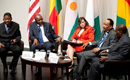
4 Francophone African Presidents speak at USIP

African Presidents at USIP Link Democracy, Security

The elected presidents of four West African nations, appearing at USIP, called for consolidating democratic advances in their countries after what for most has been a debilitating period of conflict, dictatorship and political struggle. | Read about the USIP event with the presidents of Benin, Niger, Cote D'Ivoire and Guinea http://click.newsletters.usip.org/?qs=994cde0d6eadcbbd7851f53682e4a058f03abb0dfd7410c974c45c8c6b817192

Thursday, June 9, 2011

"How France Lost Africa to the U.S." or "What's New? I mean it's France" or "Why ACSS is great!"

This article is by G. Pascal Zachary (a former foreign correspondent for The Wall Street Journal, author of Married to Africa,  a professor of practice at the Walter Cronkite school of journalism at Arizona State University).  In a complete aside, check out the link to his book.  It looks like a very interesting read that would offer a more personal look into life in Africa. 


First of all, The Atlantic is one of my favorite magazines.  They publish consistently engaging articles and usually at least one that's Africa related (and a subscription is only $12 a year or so) each month.


This article immediately caught my attention because half of the nurses that my beautiful wife works with in her hospital are from various African countries.   I was surprised to read how closed off/caste-like the french business world is to European-educated Africans--I'd be curious to hear a counter-argument from a french businessman/company. 


 How France Lost Africa to the U.S. - The Atlantic


I've also included the abstract to the paper mentioned in Zachary's article.  Unfortunately neither you or I can cannot read the entire paper without subscribing to African Affairs (don't worry, it's not a dating website) or paying a one-time use fee of $25 !!!!!! (hahahah, seriously?) to read the article.  A subscription to the magazine (published 4 times a year) is only $22.  Wouldn't it be better to just charge .25 an article that would be available through a one-click connection to a paypal account (my .02). 


OR, as I just found out, if you have access to PROQUEST (through MERLN) you can read the whole article (and the whole magazine) for free.  How do you get this access you ask?  It's easy, you attend the great week-long "Introduction to African Security Affairs" course (or any of the other phenomenal ones they teach) that the Africa Center for Strategic Studies (ACSS http://africacenter.org/) puts on at least once a year.  All alumni from ACSS get access to MERLN!

Diaspora, faith, and science: Building a Mouride hospital in Senegal
by Ellen E. Foley and Cheikh Anta Babou
Ellen E. Foley (efoley@clarku.edu) is an Assistant Professor of International Development and Social Change at Clark University. Cheikh Anta Babou (cheikh@sas.upenn.edu) is an Associate Professor of History at the University of Pennsylvania.

Abstract
This article examines a development initiative spearheaded by the members of a transnational diaspora – the creation of a medical hospital in the holy city of Touba in central Senegal. Although the construction of the hospital is decidedly a philanthropic project, Hôpital Matlaboul Fawzaini is better understood as part of the larger place-making project of the Muridiyya and the pursuit of symbolic capital by a particular Mouride dahira. The dahira's project illuminates important processes of forging global connections and transnational localities, and underscores the importance of understanding the complex motivations behind diaspora development. The hospital's history reveals the delicate negotiations between state actors and diaspora organizations, and the complexities of public–private partnerships for development. In a reversal of state withdrawal in the neo-liberal era, a diaspora association was able to wrest new financial commitments from the state by completing a large infrastructure project. Despite this success, we argue that these kinds of projects, which are by nature uneven and sporadic, reflect particular historical conjunctures and do not offer a panacea for the failure of state-led development.


Links:
Diaspora, faith, and science: Building a Mouride hospital in Senegal
How France Lost Africa to the U.S. - The Atlantic
http://africacenter.org/
http://africacenter.org/2009/12/introduction-to-african-security-issues/
Married to Africa