FAO Quotables

"But being right, even morally right, isn't everything. It is also important to be competent, to be consistent, and to be knowledgeable. It's important for your soldiers and diplomats to speak the language of the people you want to influence. It's important to understand the ethnic and tribal divisions of the place you hope to assist."
-Anne Applebaum

Showing posts with label United Nations. Show all posts

Saturday, April 6, 2013

April 6th: 19 Years since the genocide in Rwanda and Eleven Things You Should Know About the Genocide in Rwanda

   April 6th: 19 Years since the genocide in Rwanda and

Eleven Things You Should Know About the Genocide in Rwanda


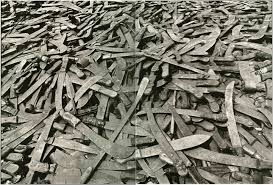
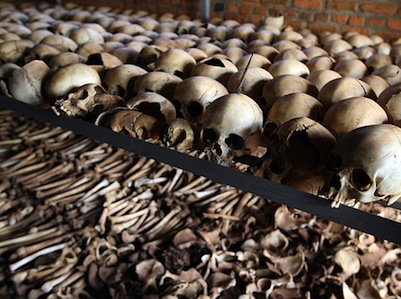
       A brutal and evil campaign started today 19 years ago.  Over the following 100 days, the Hutu government planned and sponsored the murder of nearly a million people: men and women, children and babies--most of them split open and hacked to death with machetes like this:


It's worthwhile to pause today and recall this heartbreaking tragedy and perhaps discuss it with 
your family and kids (once they are old enough).  When my daughters are older, I plan on sitting down with them each year and watching one of the films below, or discussing one of articles/books that I've listed below.  It's important that we acknowledge that this genocide occurred, that we analyze why and how it occurred, and that we recognize the brave sacrifices of the men and women who DID DO something during the genocide.  Finally, despite the rhetoric of "never again", its important to keep at the forefront of our dialogue that IT IS possible for such a genocide to occur again if we (i.e., the international community on the macro level and you and I on the micro level) don't remain diligent, vigilant and proactive.

Martin Luther King Jr.'s quote here is an apt one:
"In the end,
we will remember
not the words of our enemies,
but the silence of our friends."


Eleven Things You Should Know about the Genocide in Rwanda (and which I didn't know either until I wrote a paper about it):


1. In 100 days, Hutu extremists killed 800,000 men, women and children--507,000 of them Tutsis (77% of the registered Tutsi population).  That's about 11% of their population.  That would be the equivalent of 26 million people being killed in the US over a 3 month period.

2. The U.S. government (USG) acknowledged early on (on 28 April to be exact, when there were at least 100,00 already dead) that people were being slaughtered, but instructed its UN Ambassador to remain in "listening mode" and "not commit the USG to anything."

3. The best and most complete account of the genocide is the Alison Des Forges' (of HRW) Leave None to Tell the Story.

4. A shorter but equally excellent read is Samantha Powers' damning condemnation of the U.S. government's silence (i.e., inaction) in "Bystanders to Genocide" from the Atlantic Monthly.

5.The USG's belated humanitarian response (after the genocide was over) actual enabled many of the killers to escape the country through the refugee camps.

6.  Hutu hate radio broadcasts were used to incite and organize the killings--the USG had the capability to jam these broadcasts but deemed it too expensive.

7.  The NSA archive is a non-profit group run through George Washington University that archives thousands of previously classified documents (obtained through FOIA) that lend a primary source look into look at hundreds of events in our nation's history.

8.  Never again?  It could happen in Syria.

9.  What constitutes "justice" and reconciliation after the genocide is a lot different than you might imagine (See Gourevitch's top-notch New Yorker Article)

10. In 2001, there was a backlog of 100,000 perpetrators waiting to be tried--this is one reason Kagame instituted the gacaca "grass courts."

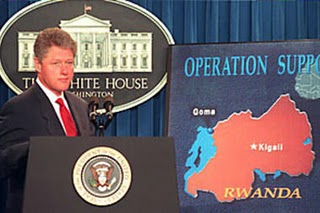
11.  President Clinton's March 1998 apology in Rwanda may have been technically accurate: "we in the United States and the world community did not do as much as we could have and should have done to try to limit what occurred," however, in reality the U.S. didn't just not do as much as it should have, instead officials in the U.S. government willfully and aggressively pressured the international community to not only withdraw peace-keeeping forces but also prevented others from intervening.

FILMS:
Most people have seen or are familiar with the superb movie Hotel Rwanda.


Another movie on the genocide is the vivid and heartbreaking Sometimes in April.  I wrote a paper evaluating the Raoul Peck's masterpiece here.


A few others that are on my "to watch" list are:
Shake Hands with the Devil: The Journey of Romeo Dallaire (2005)


Shake Hands with the Devil (2007)


That Spring in 1994: What I Remember—Recollections of the Rwandan Genocide

That spring in 1994, I was 15 years old and a freshman at Bedford High School in Massachusetts.   Searching my memory of that period, I can't uncover even a faded polaroid recollection to give witness to the murder of almost a million men, women, boys, girls and babies. 

That spring

I remember working as a bagger at the grocery store on Hanscomb Air Force Base. 
I remember fleeing the base theatre with my friend CJ after we lit up cigars during a movie.
I remember the field where I would play soccer by my school.

What I can recall

I close my eyes and I can smell the dusty paper of the grocery bags.
I close my eyes and I can feel my heart racing as we were chased out of the theatre.
I close my eyes and I can see the long and overgrown green grass of the soccer field.

That same spring

Nearly a million people's last breath and smell was rotten and rife with
sweat, urine, and blood.
Murderers crushed and ripped apart nearly a million hearts.
Murderers smashed shut nearly a million sets of eyes. 

That same spring

Millions of people

knew.

And millions of people did

nothing.

Today
            Today
                        Today
                                    Today
                                                          and everyday

I trudge with the grief of my own ignorance
like an iron yoke
on the shoulders
of my soul.

Sunday, November 11, 2012

Somalia Situation and South African Strategy


Somalia Situation and South African Strategy

Below are two articles from an excellent weekly Africa email list serve that I am on.  

United Nations
RESOLUTION – UN Resolution 2073 - The Situation in Somalia (07 Nov 12) [LINK]


DefenceWeb
South Africa’s Strategic Options (10 Oct 12)
Written by Helmoed Römer Heitman
South Africa faces a number of defence and security challenge and consequently needs to develop forces that provide a useful degree of security against internal and external threats. Defence analyst Helmoed Römer Heitman looks at how South Africa needs to decide its place and role in Africa and in relation to the international community, and the way it must then develop its foreign and defence policies and structure its armed forces.


Thursday, April 12, 2012

Is the UN Charter Relevant in the Twitterific Age of Intervention?

BONUS LINK:  My entire (so far) grad school notes collection can be found here. 

Is the UN Charter Relevant in the Twitterific Age of Intervention?


            Both liberals and realists would agree that there are scenarios that call for or require intervention in the internal affairs of other sovereign states.  Speaking on the idea of collective global security Kofi Annan said, “In our globalized world, the threats we face are interconnected . . . whatever threatens one threatens all.” (Lauren, Craig, George, 272).  Annan overreaches in his statement and it is in the application of the limitations and requirements for intervention that realists and liberals disagree today.  It is only in the reconciliation of realist and liberal approaches that a system balancing restraint and freedom can not only be developed, but most importantly applied.  Most notably the international community set out to do just this after World War II with the United Nations (UN) Charter.  While well intentioned, this system has not changed in concert with advances in technology or with the shift in the international balance of relative power. 
            A key feature of the Westphalian Order, still largely in place today, is the mutual respect for sovereignty among nation states.  Although this respect is lessening, most states feel obliged to provide a modicum of international legal justification before interfering in another state’s domestic affairs and even name interventions with this in mind.  The U.S. dubbed their invasion of Panama, “Operation JUST CAUSE.”  Realists focus on the autonomy, power, and security of sovereign state actors and are invested in the modern state system and thus have a higher bar.  Nevertheless, one could see realist support for the U.S. intervention in Pakistan in defense of Afghan sovereignty and the aforementioned invasion of Panama based on the threat to the U.S. of Noriega’s facilitating drug running into the United States.  The liberal viewpoint, with its focus on the interdependence of not only state actors, but also organizations and institutions, and the promotion of human rights, provides to a large measure the basis for the recent series of “humanitarian interventions” such as the 1999 NATO bombing of Yugoslavia and its most recent involvement in the Libyan Civil War.  
            Thus a realist might also favor intervention when it contributes to the international balance of power and order.  Although there was an obvious ideological component to the U.S. policy of containment during the Cold War, each side viewed challenges to its sphere of influence as a zero-sum game exemplified by the 1983 U.S.-led invasion of Grenada in response to what was viewed as the Soviet-backed, Cuban militarization of the island.  A liberal might demand intervention in the same situation but for very different reasons—namely because the intervention would enable the independence of the people and the government (Nye, 169). 
            Although imperfect in design and often execution, the UN Charter represents a pragmatic reconciliation of the realist and liberal approaches and more importantly, addresses both the limitations and obligations of states in intervention.  The UN Charter sought to provide a structure to address, evaluate and ratify (when applicable) calls for intervention.  Specifically, Chapter VII (Action with Respect to Threats to the Peace, Breaches of the Peace, and Acts of Aggression) does provide a single standard.  Article 39 states: “The Security Council shall determine the existence of any threat to the peace, breach of the peace, or act of aggression and shall make recommendations, or decide what measures shall be taken . . . to maintain or restore international peace and security.” The Security Council has a vested interest in maintaining international balance of power, and the UN provides the framework for nations to make decisions together.  This framework and Chapter VII mandate does not encompass intervening actions like public appeals by government leaders or officials.  Nye describes this wide range of possible actions that build from words to steel (Nye, 166-7).  When “steel” is needed, Article 43 obligates all UN members to contribute as required, but sets a limit on this contribution by including those members in UNSC’s decisions and by allowing them to bring any economic problems to the UNSC as well.  Although the charter has no real enforcement mechanism for states that refuse to participate, the Charter is an improvement over the legal framework of the League of Nations—as it better balances national sovereignty with international legal obligations (and includes the U.S. as a member).  Finally the charter is clear that nothing “shall impair the inherent right of individual or collective self-defence” (UN Charter, Article 51).  This charter has been criticized, however, for taking too soft an approach to human rights in favor of sovereign ones (Lauren, Craig and George, 76).
            Although the Charter limits U.N.-approved or sponsored intervention with fairly clear criteria, these criteria have been more broadly applied during the late two decades.  Of late, the UN’s loose interpretation of threats to “international peace and security” raises the question of inconsistency. Why did it condone interventions in Iraq and Libya, but does not intervene in China’s violent suppression of public dissent?  This, of course, stems from China’s veto power on the UN Security Council.  One contributing factor may be the 24-hour news cycle for which a closed society like China’s is less vulnerable.  Today it is public opinion, forged by the continual bombardment of images and information, which creates the impetus for action more so than any rigorous evaluative series.
            Without a standard interpretation of Article 39, the UN must create a framework of evaluation for intervention.  First and foremost, the tripwire to intervene must be when the internal threatens the external—when the abuses occurring within a country affect the peace and security of the international community.  It is at this juncture that the obligation must be separated from the limitation.  The international community must agree to intervene but must embrace Huntington and ensure that the intervention itself is regionally led.  The application of sub-state theory is applicable here; those countries in  their region can better understand their culture (strategic and otherwise), and are in the best position to use soft power to affect change.  That soft power traditionally has not been systematically applied in this manner is perhaps why its effectiveness has been limited (Nye, 63-4).  This regional intervention combines the liberals’ focus on interdependence with the realists’ need for power and security. 
            Although flawed and in need of an update to reflect the modern international system, the provisions on intervention in the UN Charter provide satisfactory resolution to the tension between obligations and standards, or limits, on intervention.  The Charter uses a liberal lens to promote international peace and security while providing a realist mechanism to implement said peace and security throughout the globe.  Once must question, though, whether the current trend toward humanitarian intervention can be sustained.  As an increasing number of nations such as Mexico show signs of devolving into failed states, the international community will continue to be challenged to set boundaries on and provide justification for intervening in what were considered until recently, purely domestic issues within sovereign states.  The challenge is for the standards and means of intervention to fully evolve with technology and the role of transparency.  While certain factors like human nature remain timeless, the 24-hour news cycle is already quickly morphing into the 1,440 minutes (and one day the 86,400 seconds) news cycle with a real-time global flow of news and reporting.  The world must not pay mere lip service to former Secretary General Daj Hammarskjöld’s comment that the “United Nations reflects both aspiration and a falling short of aspiration.  But the constant struggle to close the gap . . . makes the difference between civilization and chaos.” (Lauren, Craig, and George, 129).  The struggle in this case must be to keep pace with an increasingly interdependent world and to intervene consistently and only when required. 


 Bibliography


Tuesday, April 10, 2012

Would You Buy Tickets to Concert of Democracies?

BONUS LINK:  My entire (so far) grad school notes collection can be found here. 

Concert of Democracies as the Answer to the Impotent UN

           Kant held that a “perpetual peace” could only be reached after a long period of attempts and failure, but emphasized that once realized, it would solidify global  “republican freedom” (Doyle in Betts, 140).  Fukuyama held the global triumph of liberal democracy as the evolutionary embodiment of perfection in international relations (Fukuyama in Betts, 7).  The idea of a “Concert of Democracies (COD)” stand as Ikenberry and Slaughter’s answer, marriage and implementer of Kant’s and Fukuyama’s philosophical thesis.  The authors charge that ultimately U.S. Strategy is to guard its citizens and culture by ensuring safety within its borders, a thriving international economy, and a non-combative cooperative global security environment.  (Ikenberry and Slaughter in Betts, 625).   The COD achieves this strategy by bolstering security cooperation between liberal democracies of the world, effectively creating the framework to codify and implement the “democratic peace” (I and S in Betts, 627).   While Ikenberry and Slaughter’s COD theoretically appears to be viable solution, in execution it could potentially isolate and enervate non-democratic allies, worsen the already questionable efficacy of the United Nations (UN), and discount the critical and rising global role of non-state actors.           
            The merits of a COD fall into the realm of the benefits of collective strength and security.  This concert has already been done on a small scale with alliance building in the past.  There are many examples, most notably President Bush Sr’s first Gulf War coalition.  Although not composed entirely of democracies, the UN Security Council acted to ensure a collective security through a collective response (Lauren, Craig and George, 84).  The unanimity of the Western democracies and Japan acting in concert generated a moral certainty that contributed to the ability of states such as Syria and Egypt to send large combat units in support of alliance efforts.  Additionally, the effect on public opinion in democracies of an awareness that like political entities share a common cause cannot be underestimated in facilitating long-term support for a policy or course of action. 
            One drawback of such a concert is that it serves to isolate non-democratic allies needlessly. While there are few, if any, instances where China and Russia would be offended not to be included in such a concert, there are allies that might take offense. 
Morocco is one of America’s oldest allies but is certainly no democracy (although their diplomatic corps would argue otherwise)—this speaks to a major uncertainty—who makes the cut?  While Ikenberry and Slaughter state that membership will be “self-selective,” this is not always possible.  In making the cut you are unnecessarily excluding potential partners with shared interests, but without liberal democratic forms of government.  Perhaps the biggest drawback to a COD is that typically it will react slowly to a crisis in an effort solidify broad support among its fellow democratic states.  This sluggish response time only allows a crisis to worsen—and could costs lives.  Furthermore the susceptibilities of a COD to the vagaries of public opinion make the execution and sustainment of any decision difficult.  This stands in stark contrast to an authoritarian state that is less constrained and can make quick and unanimous decisions—this is especial problematic because they are the COD’s likely antagonists.  A less evident drawback is that smaller democratic partners may have a disproportionate voice in the course of the concert because of the negative perception that could result if the COD appears to fracture.  It is also dangerous to assume that simply because a nation is a liberal democracy means that they share our same core interests.  This can lead to the U.S. needlessly entangled with nations that possess divergent goals.
            Perhaps the largest uncertainty lies with the United Nations (UN).  Despite Ikenberry and Slaughter’s assertions to the contrary, the COD cannot coexist with the UN—at least not with the U.S. as a member of both organizations.  The success of the COD can only be inversely related to that of the UN.  This means that where the nations of the COD rise, the rest of the world falls.  Furthermore, a realist who espouses the temporality of democracies would have major issues with this concert because it unabashedly espouses the liberal democratic system as the ultimate evolutionary state of the global system.  They might further counter such a plan by echoing Lord Palmerston’s sentiment that “[there are] no eternal allies or perpetual enemies . . . only [national] interests” (Nye, 66).   Finally, conflicts that may require interaction with or intervention by the COD will increasingly involve non-state actors and there is considerable ambiguity with how the COD would interact with them.  These non-state actors include ethnic groups, rebel militias, and multinational corporations, all whose core interests may be asynchronous or non-tangential to the values of liberal democracies. Finally, the COD discounts the role of the most important non-state actor, the economy.  The rise in importance of the global economy as an institution/non-state actor rivals that of many nations that would join this concert.  This rationale is in accord with Fukuyama’s assertion that nations that have achieved their “end of history” (aka liberal democracies) will focus more closely on economic relationships than political and strategic ones. (Fukuyama in Betts, 15). 
            Ultimately, one must demand: to what end?  Realists might criticize that such a concert’s merits or detractors are irrelevant—what matters is the existing balance of power and how such a concert might affect it.  The alienation of non-democratic allies and the debasement of the UN’s efficacy would not only throw the realists’ balance of power into disarray but could end up stunting the spread of liberal democracies.  A COD likely will not make the world free from war, but perhaps may make the world more prone to “just wars.”  It remains to be seen if the COD could be the progression (or perfection) of Kant’s “perpetual peace (Doyle in Betts, 140).  To even have a chance for success the COD cannot coexist with the UN but must supplant them—a herculean—if not impossible, task.  Ikenberry and Slaughter would revel in Doyle’s assertion that “we are lovers of glory,” (Doyle, in Betts, 139), in the case of a concert of democracies, the liberal democracies of the world would be reveling too much in the glory of their “righteousness.”


 Bibliography

Thursday, February 23, 2012

The Guilt of the Silent: An Analysis of Raoul Peck's "Sometimes in April"

    BONUS LINK:  My entire (so far) grad school notes collection can be found here. 

 In the spring and summer of 1994, I was 15 years old and a freshman at Bedford High School in Massachusetts.   Searching my memory of that period, I can't recall even a quick polaroid recollection concerning almost a million people's murder.  

That spring

I remember working as a bagger at the grocery store on Hanscomb Air Force Base.  
I remember fleeing the base theatre with my friend CJ after we lit up cigars during a movie. 
I remember the field where I would play soccer by my school.

What I can recall

I close my eyes and I can smell the dusty paper of the grocery bags.
I close my eyes and I can feel my heart racing as we were chased out of the theatre.
I close my eyes and I can see the long and overgrown green grass of the soccer field.

That same spring

Nearly a million people's last breath and smell was rotten and rife with sweat, urine, and blood.
Murderers crushed and ripped apart nearly a million hearts.
Murderers smashed shut nearly a million sets of eyes.  

That same spring

Millions of people 

knew.

And millions of people did

Nothing.

Today
Today
Today
Today
and everyday

I trudge with the grief of my own ignorance like a iron yoke on the shoulders of my soul.  


The Guilt of the Silent: An Analysis of Raoul Peck's Sometimes in April

             In 2004’s Sometimes in April, director Raoul Peck creates a graphically accurate account of the genocide that began after Hutu extremists and members of the Presidential Guard shot down a plane carrying Rwandan President Habyarimana and Burundian President Ntaryimira on 6 April 1994.  This event ignited a killing spree that spread from Kigali throughout the country, claiming the lives of over 800,000 people—507,000 of them Tutsis (77% of registered Tutsi population), [i] in the span of 100 days. [ii]  While the film’s details of these 100 days reflect years of careful research by the director, Peck neglects several key elements whose inclusion would strengthen his story’s purpose.  From the start, the movie falls short in offering deeper context to the relationship between the Hutus and Tutsis throughout Rwanda’s history.  While the film captures the inaction of the international community throughout the genocide well, the director’s decision to ignore the negligence and lethargy of specific individuals and administrations is a disservice to all those killed.  Lastly, the film fails to address the significance of current Rwandan President Paul Kagame’s decision to initiate countrywide gacaca “grass courts” in 2001 in the midst of continuing deliberations by the International Criminal Tribunal for Rwanda (ICTR). 
            There is little to criticize, however, in the Peck’s portrayal of the events occurring in Rwanda during the genocide.  The movie’s action hinges on the relationship between fictional characters Augustin, a moderate Hutu captain in the Rwandan military (married to Jeanne, a Tutsi), and his brother Honoré, a popular “Hutu Power” radio DJ for Radio Télévision Libre des Mille Collines (RTLM).  During the genocide, the international community protests RTLM as “hate” radio; its DJs regularly list the names and addresses of Tutsis and moderate Hutus so they can be targeted and killed.  As violence erupts, Augustin fears for his life and that of his family.  After much pleading, he convinces his brother to take his family to the Hotel Mille Collines where they will be safe, deciding that his brother’s reputation gives them the best chance to make it through the deadly roadblocks in the capital city Kigali.  After successfully negotiating a few roadblocks run by civilian militia, Honoré comes to one run by the military that he is unable to pass or bribe his way through.  Helpless to intervene, he watches in anguish as Rwandan military soldiers murder his brother’s family.  Honoré sneaks back to the pit under the cover of night—miraculously finds Jeanne alive, and carries her to a local church.  Jeanne survives and is later taken by Rwandan soldiers and gang-raped repeatedly.  In a fitting piece of justice (one based on real events), she grabs a soldier’s grenade and kills herself and a group of them after a brutal rape session, to include a complicit priest (also based on real events).[iii]  This narrative draws to a close as the Rwandan Patriotic Front (RPF), led by General Paul Kagame, defeats the Rwanda military and militias, restores order and brings the genocide to an end.  The other story told by the film, in parallel, focuses on Honoré’s trial at the ICTR ten years later, and the two brothers’ reconciliation.  The director uses their rapprochement to illustrate the complex nature of Rwanda’s post-genocide growth and progress toward normalcy. 
            The film itself begins by tracing the onset of ethnic conflict in Rwanda from the post-World War II handover of colonial control from Germany to Belgium, noting that for centuries Hutu, Tutsi, and Twa “shared the same culture, language and religion.”[iv] While it is true that they all shared a common language, Kinyarwanda, whether all three are part of the same ethnic group is a matter widely debated by scholars.[v]  Furthermore, this opening statement paints too rosy a picture, as it fails to acknowledge the Tutsi’s marked centuries-long subjugation of the Hutus.  While these details do not excuse the genocide, including them would offer insight into the psyche of the Hutus and the way in which it was manipulated, ultimately leading to decades of horrific violence.  The disagreement among scholars centers on the argument that a better description of the Hutus and Tutsis is be one of different ethnic groups living in the same society as part of a feudal or caste system.[vi]  Regardless of the debate, what is clear is that they lived in the same region among each other for more than a thousand years.  As different groups (belonging to different families and following different leaders) settled into the area, the cattle-herding pastoralists (the Tutsi people) consolidated power and militarily established a rule (under mwamis, or kings)[vii] over the region, creating an elite class that would evolve over the centuries.  Not every cattle-herder was part of the ruling class, however, and some farmers (Hutus) also rose to prominence (especially those skilled in battle).[viii]  In general, a Hutu could become a Tutsi if he bought enough cattle to elevate his social position.  Although even if a Tutsi lost all of his cattle, he would not then become a Hutu.  So until the 1800’s, the terms Hutu and Tutsi retained a degree of fluidity, and people were more apt to define themselves by a specific region or lineage than by the term Hutu or Tutsi.[ix]  It was at the end of the 19th century, as society in Rwanda became more developed and complex that a degree of rigidity emerged in how the ruling class defined itself. The Tutsi ruling class came to define themselves by their power and wealth (typically measured by the number of cattle owned). The masses and peasants did not own cattle and were thus defined as subjects, or Hutus.[x]  It is worthwhile to note, that while historians typically recount the relationship between ruler and ruled with a degree of ambivalence, conquest and violence was an essential part of it.  In the next century for instance, Hutus would call for a ban on the Kalinga, the royal Tutsi drum decorated with the testicles of defeated Hutu princes.[xi] 
            It is then unfortunate that this consolidation and modernization by the ruling class coincided with European conquest.  In an effort to maintain control and maximize economic benefit, the Belgians torqued the system already in place, choosing to conduct official communication only with the ruling class, this belief stemming from their own warped ideas about racial superiority.[xii]  This interaction carried over to the religious side as well until the 1930’s when Flemish priests replaced Belgian Catholic ones.  These typically poor Flemish priests more closely related to the Hutus economically.   So while educational opportunities came, they were the second tier ones available through the Catholic church.  In contrast, Tutsis received the superior French education available through the Belgian government.[xiii]  It is at this point that the film describes well the racial classification system put in place by Belgium, one that included identity cards that listed the bearer as “Hutu” or “Tutsi.”  In removing any chance for upward mobility among those ruled (Hutus), the Belgians fostered a growing resentment that would fester for several decades.[xiv] 
            This bitterness manifested itself in 1959, when Belgium rule ended, and power was turned over to majority rule.  On 28 January 1961, the majority (Hutus) spoke and deposed Tutsi King Kigeli V, replacing him with Hutu president Grégoire Kayibanda.[xv] Over the next several decades, hundreds of thousands of Tutsi would flee the country; by 1994 it was estimated that there were between 400-700 thousand Rwandan Tutsis living outside the country.[xvi]  It is this long history that one finds the fuel for the fire that became the genocide. 
            It is in his description of the international response to this fire that Peck falls short.  The film’s primary focus for this is through the actions of Deputy Assistant Secretary of State for African Affairs Prudence Bushnell, and through her efforts to influence the United States to act to intervene.  True to the historical record, she is roundly rebuffed by the administration above her when she tries to motivate action.   The film never names those squelching her effort, however; nor does it delve into the specific details of President Clinton’s blind eye.  These details are important because they offer insight into the U.S. decision-making process and the efficacy of the United Nations.   A day after the president’s plane is shot down, the film shows Bushnell referring to a 9-week-old CIA report that warned of the potential for widespread violence.  Bushnell is reprimanded by an older white gentlemen (one assumes this to be Secretary of State Warren Christopher) “not to bring up the CIA report again.”[xvii]  The pacing of the film’s cuts to the inaction in Washington exacerbates the lack of detail.  In offering only infrequent cuts, Peck fails to tell the viewer the scene’s place in the genocide’s timeline.  Thus when the films shows an internal USG debate via teleconference regarding the possibility of jamming the hate radio stations (a measure deemed “too expensive and illegal”)[xviii], the viewer doesn’t know that this debate occurred on or about 5 May, nearly a month after the killings (roughly 200,000 dead)[xix] began.[xx]  Other than a few news clips of State Department officials playing semantics with the term genocide on Day 65 of the crisis (620,000 killed),[xxi] and a final shot of a nameless White House official thanking Bushnell for her team’s work on the U.S. belated humanitarian response (which actually aided the escape of many of the murderers), no other evidence of America’s action is investigated.  
            This omission is unfortunate because there are hundreds of previously classified documents (all available at the time of the filming) that make it clear that the U.S. was aware of the slaughter and murder of civilians at the highest levels, and not only did nothing, but in some cases made efforts to ensure others did nothing as well.  Partly in response to a request from the Belgian government for “cover’ in their withdrawal[xxii], on 15 April (64,000 dead)[xxiii] Christopher sent a cable to the U.S. Mission to the United Nations.  In it he stated the U.S. position that the United Nations Assistance Mission in Rwanda (UNAMIR) must be withdrawn, an imperative that would be echoed during a Security Council meeting at which the Rwandan ambassador was present and able to communicate the information back to the genocide’s perpetrators.[xxiv]  The Clinton administration, through National Security Advisor Anthony Lake, continued to receive intelligence reports on the killing to include a 26 April one stating that at least 100,000 had been killed.[xxv]  Perhaps most damning, however, is a 21 April letter from Rwandan human rights activist Monique Mujawamariya to President Clinton; in the letter she writes of the genocide occurring and the dire effect that a UNAMIR drawdown would have.[xxvi]  Clinton had met Mujawamariya the previous year and when she went missing in Rwanda in early April, finding her became a central task for his staff.[xxvii]  After she managed to escape Rwanda and was found, however, her pleas—and her letter, went ignored by the White House.  At the United Nations, the U.S. continued to stymie efforts to intervene.  In a 28 April memo to Madeline Albright from Deputy Political councilor to the UN John Boardman, he cautions her to remain “mostly in listening mode… not commit [the] USG to anything.”[xxviii]  Early wording in the same memo makes it clear that the U.S. was aware of “atrocities” being committed in Rwanda.  The ambivalence and impotence of the White House is best shown in that Rwandan assets in the U.S. were not frozen, and diplomatic relations with the genocidal government were not cut off until 15 July, 11 days after the genocide’s end.[xxix]  During the films final seconds, the words, “Of those who watched the genocide unfold and did nothing to stop it, no one has been charged” appear on the screen. By using these documents, and countless others available, Peck could have made clear exactly who those who watched the genocide unfold were.
            Finally, the film shows both the ICTR, as well as the gacaca courts taking place in the countryside villages where the genocide occurred.  The gacaca courts were instituted to address the backlog of 110,000 alleged genocide perpetrators in 2001.[xxx]  Widely criticized by human rights activists, the informal courts (led by ‘judges’ with only a modicum of legal training) were held in the villages where the crimes occurred, and allowed victims to confront their attackers directly.  Peck fails to show these controversies, however; nor does he show that in some cases the criminal’s confession itself was his only punishment (in many cases it was a combination of confession and time served).[xxxi]   While the competing ideas of retribution and justice in post-genocide Rwanda may have been too large a project to address in an already long (2 hour and 15 minutes) film, the director could have made clear that the gacaca courts were a deliberate effort by Tutsi President Kagame to help rebuild a sense of normalcy and an ability for Rwanda to move forward.[xxxii]  In one of the most densely populated countries in Africa,[xxxiii] it was clear that Hutus and Tutsi would have to live amongst each other as their country recovered. 
            Given an event as large and complex as the genocide in Rwanda, Peck does an admirable job in addressing the ways in which the extremist elements of the Hutu military and political militias took advantage of the Tutsis’ past systemic subjugation of Hutus.  The pervasive power of this propaganda is well illustrated in the character of hate radio DJ Honoré.   As Peck superbly captures the graphic and explicit imagery of genocide, he is in his element, creating scenes that cannot be ignored, nor ever forgotten by the viewer.  Thus it is all the more unfortunate that the film’s beginning words by Martin Luther King Jr., “In the end, we will remember not the words of our enemies, but the silence of our friends”[xxxiv] are not fully honored by naming those silent offenders in the United States.  Perhaps by holding these mute transgressors accountable, future atrocities can be prevented.   


Notes

            [i.].  Alison Liebhafsky Des Forges, Leave None to Tell the Story: Genocide in Rwanda, (New York: Human Rights Watch, 1999), 15.
           
            [ii].  Frontline: Ghosts of Rwanda, “Timeline,” last modified April 1, 2004, http://www.pbs.org/wgbh/pages/frontline/shows/ghosts/etc/crontext.html.

            [iii]Sometimes in April, “Director’s Commentary,” directed by Raoul Peck (2004; HBO Home Video, 2005), DVD.

            [iv].  Ibid..

            [v].  Des Forges, Leave None, 31.

           [vi.]. Paul Nugent, Africa Since Independence: A Comparative History, (New York: Palgrave Macmillan, 2004), 51, 499.

            [vii].  Wayne Madsen, Genocide and Covert Operations in Africa, 1993-1999, (Lewiston, NY: Edwin Mellen Press, 1999), 100.

            [viii].  Des Forges, Leave None, 32.

            [ix].   Ibid., 32.

            [x].  Ibid., 32.

            [xi].  Madsen, Genocide and Covert Operations, 101.

            [xii].  Ibid., 100.

            [xiii].  Ibid., 101.

            [xiv].  Sometimes in April, Peck.

            [xv].  Madsen, Genocide and Covert Operations, 103. 
           
            [xvi].   Nugent, Africa Since, 451. 

            [xvii].  Sometimes in April, Peck, 41:08.

            [xviii].  Ibid., 1:18.

            [xix].  Frontline, “Timeline.”

            [xx].  Frank G. Wisner, “DoD Memo, Rwanda: Jamming Civilian Radio Broadcasts,”   The National Security Archive, The Genocide and the US in Rwanda, edited by William Ferroggiaro, last modified August 20, 2001, http://www.gwu
.edu/~nsarchiv/NSAEBB/NSAEBB53/rw050594.pdf.

            [xxi].  Sometimes in April, Peck, 1:38.

            [xxii].  Samantha Powers, “Bystanders to Genocide,” Atlantic Monthly, September 2001, http://www.theatlantic.com/magazine/print/2001/09/bystanders-to-genocide/4571.
           
            [xxiii].  Frontline, “Timeline.”

            [xxiv].  Warren Christopher, “Talking Points on the UNAMIR Withdrawal,” The National Security Archive, The Genocide and the US in Rwanda, edited by William Ferroggiaro, last modified August 20, 2001, http://www.gwu.edu/~nsarchiv
/NSAEBB/NSAEBB53/rw041594.pdf.

            [xxv].  Bureau of Intelligence and Research Report: “Rwanda: Genocide and Partition,” The National Security Archive, The US and the Genocide and Rwanda, edited by William Ferroggiaro, last modified March 24, 2004, http://www.gwu.edu/~nsarchiv
/NSAEBB/NSAEBB117/Rw23.pdf.

            [xxvi]. Monique Mujawamariya, letter to President Clinton, April 21, 1994, The National Security Archive, The US and the Genocide and Rwanda, edited by William Ferroggiaro, last modified March 24, 2004, http://www.gwu.edu/~nsarchiv
/NSAEBB/NSAEBB117/RW47.pdf.

            [xxvii].  Powers, “Bystanders to Genocide,” VII.

            [xxviii].  John S. Boardman, United Nations Memo to Ambassador Albright, April 28, 1994, The National Security Archive, The US and the Genocide and Rwanda, edited by William Ferroggiaro, last modified March 24, 2004, http://www.gwu.edu/~nsarchiv
/NSAEBB/NSAEBB117/Rw12.pdf.

            [xxix].  Jared Cohen, One Hundred Days of Silence: American and the Rwanda Genocide, (Lanham: Rowman and Littlefied, 2007), 148. 

            [xxx].  Nugent, Africa Since, 484.

            [xxxi]. Philip Gourevitch, “The Life After: A Reporter at Large,” The New Yorker, May 4, 2009, http://search.proquest.com.libproxy.nps.edu/docview/233155205
/fulltext/134F41AF92127BBFB2B/1?accountid=12702.

            [xxxii]. Gourevitch, “The Life After.”

            [xxxiii]. Des Forges, Leave None, 31.

            [xxxiv]. Sometimes in April, Peck.
http://fuuo.blogspot.com/2012/02/sometimes-in-april-analysis-paper.html