FAO Quotables

"But being right, even morally right, isn't everything. It is also important to be competent, to be consistent, and to be knowledgeable. It's important for your soldiers and diplomats to speak the language of the people you want to influence. It's important to understand the ethnic and tribal divisions of the place you hope to assist."
-Anne Applebaum

Showing posts with label johnnie carson. Show all posts

Monday, June 27, 2011

FUUO is back! The State Dept on Liberia, blood diamonds, Cameroon and convicted rapists

I have been on leave for the better part of the past few weeks so I havent' posted anything in some time and thought I would kick it off with some links from the State Department Office of Transcripts :). 


Africa: Remarks With Liberian President Ellen Johnson Sirleaf <http://www.state.gov/secretary/rm/2011/06/166873.htm>
Ummm, seriously, these are all the remarks? 


Africa: Mozambique Independence Day <http://www.state.gov/secretary/rm/2011/06/166884.htm>
Yawn...

Africa: No Consensus at Kimberley Process Intersessional <http://www.state.gov/r/pa/prs/ps/2011/06/166970.htm>
Interesting because I had no clue what the "Kimberley Process" was.  Now I do and you can too: http://en.wikipedia.org/wiki/Kimberley_Process_Certification_Scheme


Africa: Assistant Secretary for African Affairs Johnnie Carson to Travel to Cameroon and Equatorial Guinea <http://www.state.gov/r/pa/prs/ps/2011/06/166984.htm>
It's notable that he's traveling to Equatorial Guinea given their leader's track record (granted he's headed there for AU summit in Malabo).

Africa: ICTR Judgment Against Former Rwandan Minister of Women's Development <http://www.state.gov/r/pa/prs/ps/2011/06/167079.htm>

Wednesday, June 15, 2011

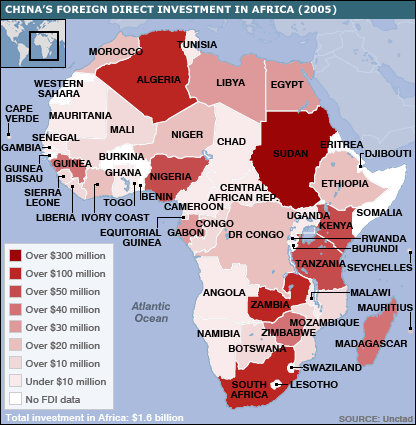
China in Africa Real Story Blog takes on Johnnie Carson and Sec Clinton


I have written about Professor Brautigam's excellent blog numerous times (China in Africa: The Real Story).  If you want to learn the real deal on what China is doing in Africa, read everything that you can get your hands on by her and Ambassador David Shinn (http://davidshinn.blogspot.com/).  Her latest posts makes some excellent points.  You can click on this post's title to read her entire post but following is the most important paragraph:

"China has a long way to go in improving its multi-faceted engagement on the continent, but the US is not there yet either. The difference is not as complete as Secretary Clinton would have us think. Pointing to the principles that do generally guide our aid, ignoring US companies happily investing with a pat on the back from the Obama administration in places like Equatorial Guinea, and then comparing our aid to Chinese aid and investment is a common debate tactic among op-ed critics (Michael Gerson did this recently in the Washington Post). I would have hoped that Secretary Clinton would do better than this. But perhaps as her major advisor on Africa (and, probably, on China's role there) is Ambassador Johnnie Carson, the person who, in the Wikileaks cables, famously dismissed China in Africa as "a pernicious economic competitor ...[with] no morals", it's not a surprise. "
Those of you who read this blog regularly know that I 'heart' Ambassador Carson, but I would tend to agree with Brautigam in this case.  HOWEVER I would add that I am sure Carson's view is slightly more nuanced than the Wikileaks cable makes it out to be. 


Friday, May 20, 2011

"AGOA is at the heart of our Africa policy" or "That heart of yours is looking pretty old and not too useful"

First for your entertainment:
FUUO's Protesters of the Week Compendium (rundown on the week protesters at the Pentagon):
http://fuuo.blogspot.com/2011/11/fuuos-pentagon-protesters-of-week.html


FUUO Past Poets of the Week:
http://fuuo.blogspot.com/2012/05/african-poets-of-week-compilation.html


Africa: Obama Administration Wants Africa Trade Act Extended to 2025
Stephen Kaufman
Washington — The Obama administration wants to reauthorize the African Growth and Opportunity Act (AGOA), which is set to expire in 2015, through 2025, Assistant Secretary of State for African Affairs Johnnie Carson says, citing the measure's success in enhancing trade levels between the United States and the African continent.
Speaking at the Center for Strategic and International Studies in Washington May 13, Carson said AGOA "remains the centerpiece of our trade and investment policy with Africa," and has "made progress in creating jobs, spurring economic growth and facilitating a dialogue on key economic and political challenges" since the legislation took effect in 2000.
In 2000, U.S. exports to Africa were valued at $5.9 billion and its imports totaled $23.4 billion. Thanks to AGOA, those levels rose to $17.1 billion in exports and $64.3 billion in African imports in 2010, Carson said. But, he added, neither the United States nor African nations should "become complacent" about the increase in trade and economic opportunities over the past 10 years.
"Africa still faces huge challenges and we need to continue and revitalize our economic partnership," he said. The region "has not experienced a genuine economic revolution."
The continent also continues to struggle to compete in an increasingly competitive global economy. "For these reasons I am fully committed to revitalizing AGOA," Carson said.
The annual AGOA Forum is scheduled to take place June 8-10 in Zambia, with Secretary of State Hillary Rodham Clinton, U.S. Trade Representative Ron Kirk and other senior U.S. officials in attendance.
Carson praised the Zambian government's planning of the event and said he expects "a dynamic forum" with a strong turnout from African government officials, civil society and the private sector.
The assistant secretary said the United States also wants to extend AGOA's Third Country Multi-Fiber provision through 2022. That provision allows AGOA member states to obtain their raw materials from other countries while maintaining preferred access to the U.S. market. He also said the administration wants to add South Africa to the provision.
A major goal for the United States is helping U.S. importers of African products increase their tax savings by eliminating the U.S. tax on repatriated revenues levied on American companies that invest in African factories that produce AGOA exports to the United States.
In prepared remarks at the same event, Deputy U.S. Trade Representative Demetrios Marantis said AGOA is "at the heart of our Africa policy," and it has defined the U.S. trade relationship with the continent for three presidential administrations.
"In the same way that the United States uses trade to increase exports, grow our economy and support jobs here at home, our Africa trade policy helps Africans grow their economies and create jobs through exports," he said.
But because many studies show that African economies continue to face constraints, a lack of trade capacity, or are "otherwise insufficiently competitive to take advantage of export opportunities," the Obama administration is asking "tough questions" about the impediments to Africa's continued economic growth, he said.
Marantis cited reports of bribes and unnecessary checkpoints within and between countries in West Africa as well as poor infrastructure and customs delays that hurt African agriculture exports.
"These are real problems that hurt Africa's competitiveness. And these problems mean that much of AGOA's potential remains untapped," he said.
The Obama administration is intent on finding the "right, informed answers" behind the constraints to African economic growth, and those answers "will shape the future of our Africa trade and investment policy and anchor our ties to this important part of the world," Marantis said.
(This is a product of the Bureau of International Information Programs, U.S. Department of State. Web site: http://iipdigital.usembassy.gov/iipdigital-en/index.html)


Tuesday, May 17, 2011

Better Late than Never: Johnnie Carson's Senate Testimony

As always, when Assistant Secretary writes/speaks I read/listen (and takes lots of notes)!


FY2012 Budget Request for U.S. Policies on Africa
Testimony

Johnnie Carson
Assistant Secretary, Bureau of African Affairs
Senate Foreign Relations Committee Subcommittee on African Affairs

Washington, DC

April 14, 2011

________________________________


I would like to thank you, Chairman Coons, Ranking Member Isakson, and all the members of the Committee for inviting my colleagues and me to testify today on the President’s budget request for sub-Saharan Africa. As this is my first appearance before this Congress, I wish to congratulate you Chairman Coons on your election to the Senate and for assuming the leadership of the African Affairs Subcommittee as a new member. Senator Isakson, congratulations on your reelection and for remaining as the minority leader of the Subcommittee. I greatly appreciate your passion for Africa and commitment to realizing our nation’s goals and interests there.

The President’s FY2012 request for sub-Saharan Africa reflects our core U.S. priorities and interests in Africa. I would like to highlight those priorities, interests, and some of the major policy challenges and opportunities we face on the continent.

We remain committed to five overarching policy priorities: 1) strengthening democratic institutions and the rule of law; 2) encouraging long-term development and growth, including food security; 3) enhancing access to quality health care and education; 4) assisting in the prevention, mitigation, and resolution of conflicts; and 5) working with Africans to address transnational challenges, including terrorism, maritime security, climate change, narcotics trafficking, and trafficking in persons.

The FY2012 request of $7.8 billion represents a 10 percent ($732.7 million) overall increase from the FY2010 enacted total of $7.0 billion. This increase is due in large measure to increases requested for each of the Presidential Initiatives. The request for Global Climate Change has increased by 140.9 percent ($73.7 million), Feed the Future by 20 percent ($84.4 million), and Global Health by 12.6 percent ($601.22 million). Our request for discretionary funds to support noninitiative programs is $1.8 billion. They include programs focused on enhancing democracy and governance, economic growth, conflict resolution, and transnational issues.

The United States has many challenges and commitments around the globe, but it is important for us not to lose sight of our growing national interests in sub-Saharan Africa. Sub-Saharan Africa is a region where the United States has benefited from longstanding partnerships and friendships and enjoys some of the highest approval ratings in the world. The ties between Americans and Africans are deep and historic.

With few exceptions, Africa is not a place where we see anti-American demonstrations and rhetoric. That is indicative of the prevailing appreciation for our country’s longstanding commitment to democracy and human rights, and for our steadfast support in addressing Africa’s many challenges and during times of trouble. The spread of democracy in Africa over the past two decades and the vibrancy of pro-democracy activism across the continent is further evidence that most Africans share our political values.

In the international arena, we might not see eye-to-eye with Africans on every issue, but, overall, most governments there have been cooperative as we deal with a variety of global challenges such as international terrorism, Iran, and piracy. We saw one recent example of this when Gabon, Nigeria, and South Africa voted in support of the U.N. Security Council resolution authorizing the use of force to avert a humanitarian catastrophe in Libya.  Our economic interests in Africa are clear and compelling.  Approximately 14 percent of U.S. oil imports come from the region, making it a strategic part of our energy security portfolio. Imports from Nigeria alone are about 9 percent of our total oil imports and almost the same volume as those from Saudi Arabia. With promising exploration and development in countries such as Ghana, Uganda, Liberia, and Tanzania, sub-Saharan Africa’s significance for global oil and gas markets will only increase in the coming years. Africa’s enormous share of the world’s mineral reserves is vital for sustaining continued growth of the global economy. And, most importantly, sub-Saharan Africa’s growing population makes it a market where U.S. firms will need to be players if they are to remain globally competitive. The region’s share of the world population today is approximately 12 percent, and it is estimated to grow to 20 percent over the next two decades.

Helping African countries, no matter how small and poor, realize their full potential and succeed as economically viable democracies is in our national interest. If fledgling democracies are allowed to fail and undemocratic regimes are allowed to endure unchallenged, then people will lose confidence in democracy and free market economic principles, and we will find ourselves on the defensive in the global competition for influence and ideas. Many sub-Saharan African countries face enormous challenges to their survival as functioning states, and we must continue to help them meet those challenges so they can better help us as we deal with our own. In the coming years, African cooperation will be increasingly essential in managing a wide range of global issues such as smuggling, piracy, migration, climate change, infectious disease, and food production.

With our limited resources and personnel, we are managing a long list of near and long-term challenges that have a direct impact on U.S. security, political, economic, and humanitarian interests. Nigeria, where I was this past weekend, is in the middle of a tense election process that will have serious repercussions for its near and long-term stability. In Sudan, the six-year-old North-South peace process is at an extremely delicate moment with independence for the South just about three months away. Diplomatic efforts on Darfur are accelerating again, but a solution is still far away. The situation in Somalia remains especially volatile and poses security threats throughout East Africa and in the Indian Ocean. We may also be on the precipice of a humanitarian catastrophe there as food supplies once again run low.

The political crisis in Cote d’Ivoire has escalated into armed conflict and unleashed one of West Africa’s worst humanitarian crises since the Liberian war. The eastern region of the Democratic Republic of Congo (DRC) remains highly insecure, especially for women and children. That country is scheduled to have elections in November that will serve as a bellwether for its post-conflict transition. Uganda and its neighbors are struggling to eliminate the Lord’s Resistance Army, which still threaten civilian populations in northern DRC and the Central African Republic. In Zimbabwe, President Mugabe and his ruling ZANU-PF party continue to obstruct the democratic process and mismanage the economy, creating a persistent and long-term threat to the country’s overall stability.

Beyond these fast-moving issues which dominate the headlines, our government is trying to address a number of slower moving but nonetheless high-impact challenges. The greatest of these is the prevalence of HIV/AIDS and other infectious diseases which have tragic consequences for economic livelihoods and social welfare of Africans across the continent. My colleague, Ambassador Eric Goosby will address this in greater detail. It is estimated that some 22.5 million Africans are living with HIV/AIDS, about two-thirds of the world’s total. Millions more suffer and die regularly from malaria and other debilitating but preventable endemic diseases. Women and children suffer disproportionately.

Although a handful of African countries have demonstrated improved rates of macroeconomic growth compared to previous decades, the overall poverty and social indicators for much of the continent are sobering. Ethiopia’s per capita GDP, for example, is $344. Life expectancy in Nigeria is 48. Basic infrastructure is lacking in many countries struggling to keep up with their growing populations, especially in urban areas. As of last year, Southern Sudan had only 50 kilometers of paved road. And food security remains an ongoing concern across much of the continent.

I have already alluded to some of the many security challenges in Africa. There are others such as the presence of terrorist groups and drug traffickers in the Sahara, and the ascendance of drug trafficking in countries such as Guinea-Bissau and Mozambique. Our referred approach to all of these challenges is to work through African security and judicial institutions and develop their capacity rather than rely on direct and potentially costly U.S. involvement. This approach may be slow and imperfect, but we believe it is the only truly sustainable one for the African context, and it is the most cost-effective approach for the United States. When Africans take ownership of their own security responsibilities, we are more likely to have the requisite trust and political buy-in of key players than if quick-fix solutions are imposed by outsiders. And this buy-in is what can lead to more durable outcomes.

To put it differently, the more proactive we are in encouraging and supporting African-led security initiatives, the less likely we will need to intervene directly down the road.  Africa’s complex challenges demand considerable time, attention, and resources, but we must also be attentive to the significant gains and progress that have occurred in many countries over the past decade, and ensure they continue. Liberia and Sierra Leone, for example, require our engagement and support to help sustain their largely successful postconflict transitions. Helping Africa’s most democratic countries—such as Senegal, Mali, Ghana, Benin, Botswana, Cape Verde, Mauritius, Tanzania, and South Africa—continue with political and economic reforms is vital for demonstrating the sincerity of our commitment to democracy and encouraging other countries to follow their model. In recent years, regional organizations such as the African Union, Economic Community of West African States, East African Community, and the Southern African Development Community have demonstrated a growing commitment to, for example, censuring unconstitutional seizures of power, promoting economic integration, and addressing regional security problems. It is in our interest to see that these organizations continue to build capacity and become more assertive across the continent.

I have worked on Africa for my entire career of more than forty years, yet, whenever I review the budget numbers, I am still amazed at how our government manages to do so much with so little. Roughly speaking, one can easily fit the landmasses of the United States, China, and Western Europe in sub-Saharan Africa. After Southern Sudan becomes independent in July, sub-Saharan Africa will have 49 states.

We have 44 embassies, 5 consulates, and several regional platforms used by various U.S. Government agencies. Those of you who have been out to the region know most of these missions are thinly staffed with an ambassador and a handful of reporting officers and support personnel.

In closing, I would like to state simply that every dollar we invest in helping Africans to address their problems and better capitalize on their opportunities may not satisfy our high expectations for economic growth, development, health, security, and political stability, but they sure can go a long way in preventing situations from getting worse and costing us even more money down the road. And, as  Ambassador Goosby and my colleagues from USAID and the Millennium Challenge Corporation will detail in their testimonies, many of our efforts do in fact have a very positive and significant impact on the lives of Africans.

It is through these programs and our vigorous diplomacy that the United States will remain a player in Africa and protect and advance our interests there.

Mr. Chairman, Ranking Member, and distinguished Committee members, thank you. I will be happy to address your more specific questions and concerns.

Friday, April 29, 2011

Nigerian Election Remarks by Ass. Secretary Carson


If you don't already subscribe to the State Department's Africa email feeds you should.  When there are events/speeches like this one, they are automatically delivered to your inbox. 

And when it's Ass. Secretary Carson speaking, it is ALWAYS worth your time to listen.   As I have said before: Ass. Sec Carson is one of those rare individuals with whom you feel more intelligent and informed through mere osmosis/proximity.

All bold and italized comments/underlined portions below are my own.  I have emboldened some of Ass. Sec. Carson's comments for emphasis.


April 28, 2011

MS. FULTON: Good afternoon and welcome to the Department of State. Very pleased today to have with us Assistant Secretary for African Affairs Johnnie Carson to talk about the recent elections in Nigeria. He was on hand to observe personally, so he’ll be able to give you his on-the-ground accounts of the results. So without further ado, Assistant Secretary Carson.

ASSISTANT SECRETARY CARSON: Thank you very, very much. Glad to be here with you this afternoon to talk a little bit about the recent elections in Nigeria. Nigeria has just completed its most successful elections since its return to multiparty democracy in 1999. Despite some technical imperfections, those elections represent a substantial improvement over the flawed 2007 electoral process. This reverses a downward democratic trajectory and provides the country a solid foundation for strengthening its electoral procedures and democratic institutions in the years to come. The Nigerian people have shown to the world their resilience and will to have their voices heard. These elections were a real opportunity to choose their leaders.

This week, Nigerian voters returned to the polls for the fourth time and final time to select their state assembly members and governors. On April 26th, all but two states held elections. Elections in Kaduna and Bauchi states occurred April 28th to give additional time for security to return to those two areas. International and domestic observers reported the April 26th elections to be generally well organized, albeit with a lower turnout in various locations compared with voter turnout earlier this month.

Following the deplorable post-election violence of the previous week, we are heartened that many Nigerian voters went to the polls to vote in an environmentally – environment largely free of violence. We remain concerned about allegations of fraud and ballot box snatching in various jurisdictions, and we strongly urge Nigerian authorities to investigate and take corrective actions on all of these allegations. We commend the Independent National Electoral Commission and especially its chairman, Professor Jega, and the security services for addressing challenges and improving their efforts with each progressive election.  From everything I hear Professor Jega represents all that is good and holy in Nigeria.

We are confident that INEC leaders will continue to take steps to further improve the electoral process to ensure that some political actors do not divert to their old – revert to their old ways of subverting the will of the Nigerian electorate. We are partners in the international community, and will not hesitate to take appropriate action against individuals of any political party who seek to undermine the integrity of the electoral process, whether at the state, national, or local elections.  Word on the street is that one of the biggest obstacles facing Jega are a few corrupt members on INEC that he doesn't have the power to fire.

Again, we congratulate the people of Nigeria on holding very successful elections. Thank you.

QUESTION: Secretary Carson, two questions. One, the CPC has said that it has evidence of irregularities and that it plans to go to court over those. The fact that Nigerians take their issues to the courts instead of resorting to violence is important and commendable.  So question one is: To what extent do you think that the existing irregularities cast a shadow on President Jonathan’s victory? Second, and in a way the more important question is: To what extent do you think that he is likely to be inclusive going forward so as to help lay to rest or to help unify the country? Would you expect or hope, for example, that when he names a cabinet he will reach out to opposition figures? Can you give us your sense of that?

ASSISTANT SECRETARY CARSON: I hope that INEC will take seriously all allegations of election irregularity. There is no doubt in my mind that there were some imperfections, some technical problems, and probably some justified cases of rigging. But it is up to the election commission to investigate those. I do not believe that any of the irregularities or technical imperfections undermine the overall outcome of this election and that the elections do reflect the will of a majority of the Nigerian people.

I cannot say what kind of cabinet or government President Jonathan will put in place. But I do note that his vice president is, in fact, a former northern governor and that the constitution does call for the president of the country to select from individual states various cabinet members. I hope that he will act in both a responsible and inclusive manner in the selection of those individuals for his cabinet and that in doing so, he will be reaching out to heal the political divisions that were uncovered during the election process.

MS. FULTON: In the back.

QUESTION: I have a question actually about Sudan. Before we came out here, the Treasury Department pulled the Bank of Khartoum off of the sanctions list, and I wonder if you can explain that move, and then more broadly how Sudan is doing on this roadmap toward normalization with the U.S.

ASSISTANT SECRETARY CARSON: Let me say that I’m not aware of this recent decision to pull the Bank of Khartoum off the sanctions list, and so I will not comment on that.

With respect to the roadmap, we continue to see progress in the implementation of the roadmap, and we continue to encourage the Government of Sudan to continue to fulfill its obligations that remain under the roadmap. One of the most important aspects of this was the successful referenda election in South Sudan that went from January 9 to 15. That went extraordinarily well. It was largely free of violence – large turnouts, well organized, and reflected the will of the people of the South to secure their independence. We continue to encourage very strongly that the Khartoum government, the NCP, and the Southern Sudanese Government, the SPLM, to work to resolve the remaining key issues that are a part of the conclusion of the CPA. This means resolving the Abyei crisis before July 9 and resolving the issues of oil and wealth-sharing, border demarcation, as well as issues related to citizenship.  Quick, let's all hold our breaths.

QUESTION: Can I follow up on that one? Just to stay with the question of Abyei, President Bashir is quoted today as having said, quote, “If there’s any attempt to secede Abyei within the borders of the new state, we will not recognize the new state,” close quote. What is your response to that, and does that not sort of ratchet up tensions ahead of July?

ASSISTANT SECRETARY CARSON: Let me just say that those comments are not helpful at all, and they only serve to inflame and heighten tensions. It is important that both sides – those in Khartoum and those in Juba – focus intensely on trying to resolve the key issues that have not been completed under the CPA    (Collective Peace Agreement). Abyei is one of them. This must be done before July 9, and it is important that President Bashir and the President of South Sudan Salva Kiir continue to meet, negotiate to resolve these issues as quickly as possible.

MS. FULTON: Back to Nigeria?

QUESTION: Yeah. Back to Nigeria. How much do you expect these elections in Nigeria to promote efforts towards democracy in the broader region? Can you –

ASSISTANT SECRETARY CARSON: I think the success of the Nigerian elections are primarily of importance to the Nigerian people, but they also send a very strong signal across Africa. Nigeria is one of the two most important countries in sub-Saharan Africa. It is also the most populous country in Africa with 150 million people. It’s also the second largest Muslim country in Africa after Egypt.

The people of Nigeria have clearly demonstrated a desire to have a democratic government, to participate in democratically-run elections, and I think this reflects a desire of many people across Africa. It also is an indication, too, that if Nigeria, with its large size and population, can, in effect, run and manage successful democratic elections, that it is possible for many of the other smaller states to do so as well. It also indicates that the democratic trajectory not only in Nigeria, but across West Africa has not stalled but continues to rise.

QUESTION: Might you be soft-pedaling the violence a little bit? I’m reading some wire material today about perhaps 500 people killed and Christian churches set afire. And also people from the elections say that they’re very discouraged by this and that they prefer to not have an election if this sort of thing happens. Might you be looking through rose-colored glasses at this sort of thing?

ASSISTANT SECRETARY CARSON: Absolutely not. But let me first say we deplore the violence that occurred particularly after the conclusion of the presidential elections a week and a half ago. We saw widespread violence throughout much of northern Nigeria. Both the president and the main opposition candidates – both called on their supporters to not support violent activities and to work to restore peace as quickly as possible.

I think that there has been a history of violence associated with Nigerian elections in the past. But in this election, we have clearly seen a much more responsible security force and a security presence in and around the electoral sites. So it’s important that violence not be a part of the democratic process. We deplore it, and I think senior officials in Nigeria have also deplored it as well. We hope that these elections will be a baseline for greater improvement in both their technical procedures as well as in their security as well.

MS. FULTON: Do we have time for maybe one more question?

QUESTION: Can I ask about Uganda? There are reports this morning that a fourth opposition leader has been arrested, and my question is about the U.S. – the Administration’s response. Are we considering any kind of pressure on the Ugandan Government?

ASSISTANT SECRETARY CARSON: We have seen the reports of the arrest of several former presidential candidates for attempting to carry out peaceful demonstrations in Kampala that were designed to highlight rising oil and food prices. We have also seen with great concern and regret the very serious and apparent mistreatment of one of those candidates, Dr. Besigye. We have expressed our concern about what appears to be harassment of President – of Dr. Besigye. I have, myself, spoken to the Ugandan foreign minister about this and have urged that the Ugandan Government act both in a responsible and civil fashion in dealing with the arrest of individuals attempting to carry out peaceful protests.

QUESTION: When did you speak to the foreign minister about that, and was that specifically about the case that you referenced?

ASSISTANT SECRETARY CARSON: I spoke to the foreign minister today, and it was specifically concerning the apparent ill treatment of Dr. Besigye as well as the government’s reaction to peaceful protests by others.

QUESTION: And did the foreign minister give you any reason to believe that the government would seek to treat such people better and to show greater respect toward peaceful protesters?

ASSISTANT SECRETARY CARSON: He did indeed. He said that he hoped that President Museveni would be meeting with the opposition political parties and leaders on Tuesday of next week. I urged political outreach and reconciliation to resolve the differences that the government has with opposition leaders. I also encouraged that there be a scope for civil peaceful protests and that government reaction to those protests should be tempered, responsible, and civil.

MS. FULTON: Okay. And thank you for your time, Assistant Secretary Carson.

QUESTION: Thank you.

ASSISTANT SECRETARY CARSON: Thank you.