FAO Quotables

"But being right, even morally right, isn't everything. It is also important to be competent, to be consistent, and to be knowledgeable. It's important for your soldiers and diplomats to speak the language of the people you want to influence. It's important to understand the ethnic and tribal divisions of the place you hope to assist."
-Anne Applebaum

Showing posts with label fuuo. Show all posts

Monday, March 31, 2014

Latest Poetry Anthology just ordered: Invitation to a Voyage: French Language poetry of the Indian Ocean African Islands

I came across this book doing a google search on Comoran poetry--a topic that I haven't looked into much before.  My previous research had only been into Malagasy poets and among them I have only covered the incomparable romantic poet Rabearivelo:


My current job, however, covers both nations.  Finding English translations of Comoran poetry (which can be in Arabic, French or ShiaComore) is a difficult task.  Once I receive the anthology
Invitation to a Voyage: French - Language Poetry of the Indian Ocean African Islands in a few weeks expect some highlighted Comoran poems.

Here's an excerpt from the poet Djailani (from the island of Mayotte--an isle of contention between France and Comoros):

"O my land!/ forever separated from your Comorian sisters/ at the base of the Indian calabash/ a shining crescent.


Want to see what Comoros looks like?  Check out my pictures here!


LINKS:
http://powerofculture.nl/en/current/2008/october/poetryanthology


Tuesday, May 1, 2012

Nigerian Hip Hop Grows in Popularity- Video Report

Check out this 2 minutes video report on the rising popularity of Nigerian hip-hop.  This is great stuff!

Sound Soultan and mo'cheddah and vocal slender
a video of The Very Best's hit song Warm Heart of Africa with guest artist Ezra Koenig of Vampire Weekend joining Esau Mwamwaya of The Very Best. This sweet and jolly song combines pieces of my life (Columbia University and Malawi where my South African husband lived for five years). 


Links:
http://www.bbc.co.uk/news/world-africa-13356235


http://www.chinaafricarealstory.com/2011/04/new-york-city-meets-warm-heart-of.html
http://www.vh1.com/video/the-very-best/449762/warm-heart-of-africa.jhtml#artist=3204522


Tuesday, November 29, 2011

FUUO Daily Dose: Foreign Aid, Rape in the DRC and Foreign Service helps orphanages in Kenya

FUUO recommended daily dosage:

Global Summitt on AID Programs .  This summit will be occurring from today till Thursday.  Global foreign aid and assistance has not reached its potential and has yet to be effectively applied.  The scattered anecdotal success stories are overshadowed by BILLIONS wasted.  Perhaps Dambisa Moyo will deliver the keynote address.


Sexual Violence in Eastern DRC.  Just because you don't hear Secretary Clinton addressing it on CSPAN does not mean sexual violence and rape is not a MAJOR  and CONTINUING problem, especially in the DRC.   I've written about it before late last summer and discussed the logistical challenges to stopping it.
http://fuuo.blogspot.com/2010/08/some-200-women-gang-raped-near-congo-un.html
http://fuuo.blogspot.com/2010/08/secretary-clinton-speaks-out-on-mass.html

 
Associates of American Foreign Service Award Winner in Kenya.  This award rewards volunteerism abroad.  These are great stories about the power of motivated and compassionate individuals.  The Association might also be an organization that my fellow FAOs would be interested in joining.


Wednesday, November 9, 2011

Importance of writing for Foreign Area Officers (FAOs) and what to read with a Rye Manhattan

I was looking back over my notes from Aidan Hartley's The Zanzibar Chest and was reminded of why my insignificant single blog IS significant when viewed collectively.  If we as the FAO community aren't sharing our analysis and thoughts from our experiences (and the books, articles we read), then we are not doing our jobs...we are sucking, wasteful black holes accomplishing nothing. 

On a lighter note, my well-traveled grandmother (self-dubbed as Granny Nanny Darling to be specific), a former marine and peace corps officer, just finished Cocktail Hour Under the Tree of Forgetfulness which she recommends pairing with a Rye Manhattan (with a frozen Michigan cherry biensur).  This is the memoir of a girl growing up in Kenya (among other things of course) and I just added it to my amazon wish list.  Granny Nanny Darling plucked this gem from the book which sold me on it: 

A good host should never ask if their guest would like another drink, they should ask if 'they would like the other half.'

Thursday, August 18, 2011

"Famine and Photography Examined" or "The Children Cried Thunder Through My Feet"

This is an important article and is striking in its honesty and self-examination.  Particularly cogent is when he writes the following:


"Because it’s a cycle. African governments know that drought is coming and they don’t prepare. Foreign charities working there talk about long-term plans to help people become self-sufficient but they’ve been failing to achieve them for 20 years. It’s as much about politics and war and poor economic policies as it is about no rain. I’m no expert but I know that much."


I couldn't agree with him more.  The only points where I diverge (maybe) from the author is in his supposition at the end of the article that in taking pictures of people starving, he is stealing their dignity.  I think this depends entirely on one's motivation and on the permission of the person being photographed.  But obviously, there is a lot of room for debate and discussion on this subject.  

Me and the Man With an IPAD by Barry Malone.
I never know how to behave when I go to write about hungry people.

I usually bring just a notebook and a pen because it seems somehow more subtle than a recorder. I drain bottled water or hide it before I get out of the car or the plane. In Ethiopia a few years ago I was telling a funny story to some other journalists as our car pulled up near a church where we had been told people were arriving looking for food.
We got out and began walking towards the place, me still telling the tale, shouting my mouth off, struggling to get to the punch line through my laughter and everybody else’s.
Then there was this sound, a low rumbling thing that came to meet us.
I could feel it roll across the ground and up through my boots. I stopped talking, my laughter died, I grabbed the arm of the person beside me: “What is that?” And I realized. It was the sound of children crying. There were enough children crying that — I’ll say it again — I could feel it in my boots. I was shamed by my laughter.
Inside the churchyard there were tents and inside the tents children were dying.
Rows and rows of women sat on the ground cradling delicate babies. An aid worker told us we had ten minutes and so we went to work. Camera shutters clicking, pens scratching: “What’s her name? How far did she walk? How many of her kids are dead?”
Some journalists leaned down over the mothers to talk to them, some stuck cameras inches from their faces. I stood further away when taking the photos, I sat down in the dirt to interview people. I thought I was better, but I wasn’t. I was just more conceited.
I remember looking up and seeing a girl who worked at a U.N. aid agency crying. I motioned to her to get out — her tears as self-indulgent as my sitting in the dirt. And then we leave. Thank you, we say. Thank you for talking to me. Thank you for holding up your dying baby for my camera. And thank you for your dignity. Thank you for giving it to me. Thank you for letting me have it.
Because that’s the thing. An Ethiopian girl told me last week that she cried as she watched foreign journalists interviewing a Somali woman in a Kenyan refugee camp. “All she had left was her dignity,” she said. “And then they took that, too.”
She was right. And I knew that I had done that. Many, many times.
I used to tell myself that it was okay because what I did was important. A U.N. official once excitedly phoned me at 7am to tell me the U.S. had donated millions of dollars to his agency because someone from the government had read a story of mine in the Washington Post.
Another aid worker approached me in a bar in Addis Ababa. “Hey! That story you wrote about that woman? That woman who had a kid die every year for the last four years and now only has one left? Awesome, man! Awesome!”
Her name was Ayantu. I don’t know if her son, Hirbu, is still alive.
Last weekend I was there again. The U.N. loaded me and some other journalists onto one of their planes in Nairobi and we flew to a tiny village near Somalia to meet people suffering from hunger, to ask them our questions, to find the sorriest tales possible.


We jumped into an imperious row of white jeeps when we landed and swept into the village. Doors flew open, everybody walked very fast, everybody was very important.
I saw six people all firing their cameras at one bemused woman. I saw aid workers fawning over the head of the World Food Programme. I saw soldiers fanning out to protect us. And then I saw the man with the iPad. I stood and stared for some time, enjoying the deliciousness of what was one of the strangest things I had ever seen in my life.
I raised the camera.
This is what I’ll write, I thought. Not about another Ayantu. Not again.
Because it’s a cycle. African governments know that drought is coming and they don’t prepare. Foreign charities working there talk about long-term plans to help people become self-sufficient but they’ve been failing to achieve them for 20 years. It’s as much about politics and war and poor economic policies as it is about no rain. I’m no expert but I know that much.
I also know it’s wrong that every few years we’re faced with an “emergency” that could have been prevented, that aid groups must frantically try to raise money to respond, that journalists need to find emaciated babies at death’s door and film and photograph and write about them before the world gives a damn.
Part of me felt bad for publishing the photo of the man with the iPad. Because he was a good person doing his job. And because we are the same.
He comes with an iPad, I come with a notebook.
Both of us steal dignity and neither of us belong.


LINKS:
http://blogs.reuters.com/photo/2011/07/29/me-and-the-man-with-the-ipad/
http://www.reuters.com/article/2011/07/26/us-africa-famine-idUSTRE76P1A220110726

Monday, August 8, 2011

It's Official: AFRICOM moving to Hoodbridge--I mean Woodbridge!

It's Official: AFRICOM moving to Hoodbridge--I mean Woodbridge!

Since this article has broken on the esteemed Potomac Local you can pretty much take this as gospel.  I L-O-V-E the article's title by the way:  "U.S.-Africa Ops Being Lured to Woodbridge."  The word 'lure' makes it sound like AFRICOM is being beckoned to beatific Woodbridge with the candy of high speed rails into what is surely a trap of some sort!

I imagine that Woodbridge District Supervisor Candidate Chris Royse will face some mocking stiff competition from actual Congressmen in other counties/states for the prize of future AFRICOM headquarters. 

NOTE to readers: 
-It remains the official AFRICOM position that they aren't leaving Stuttgart while GEN Ham is in charge. 
-It remains the official FUUO position that AFRICOM headquarters should move to Coronado, CA (FUUO will also take San Diego proper). 

LINKS:
http://potomaclocal.com/2011/08/05/u-s-africa-ops-being-lured-to-woodbridge/

Friday, August 5, 2011

Elephants Harvested for Ivory VA Article- Sad, so save for Monday when you will already be bummed


 Wow, this is so sad.  Thanks to Deb Brautigam's excellent China in Africa: The Real Story Blog for the heads up on this article.  Most of us are already a little bummed headed back to work on Mondays so save reading the full article for then.

Agony and Ivory

Highly emotional and completely guileless, elephants mourn their dead—and across Africa, they are grieving daily as demand from China’s “suddenly wealthy” has driven the price of ivory to $700 a pound or more. With tens of thousands of elephants being slaughtered each year for their tusks, raising the specter of an “extinction vortex,” Alex Shoumatoff travels from Kenya to Seattle to Guangzhou, China, to expose those who are guilty in the massacre—and recognize those who are determined to stop it.


Abu Muqawama's Ph.D for Dummies Post- Feel Smarter Going into the Weekend

6 NOV 2012 UPDATE: 
I've added the link to a post by Chris Blattman (a professor at Columbia, @cblatts on twitter) in which he answers frequently asked questions about PhD applications.

Abu Muqawama's Ph.D for Dummies Post.

If you're like me and have no clue what it means to have a Ph. D or how to get one, you should read the below post (and the comments) from Abu Muqawama's blog.  You'll feel smarter just by reading it.  

(Unfortunately, he doesn't cover at how they go about getting those Doctor prescription pads--the sole reason I would like to get a PhD is to officially be a titled "Doctor"--I envision an office crowded with dusty books and papers and a fat square prescription pad on my desk from which I scribble prescriptions for knowledge)


LINKS:
http://www.cnas.org/blogs/abumuqawama/2011/08/phds-dummies.html
http://chrisblattman.com/about/contact/gradschool/
https://twitter.com/cblatts

Poet of the Week from Mozambique: Noémia de Sousa

My apologies for the long drought without a FUUO poet of the week. 

Noémia de Sousa (aka Vera Micaia) was born in 1927 in Maputo, Mozambique.  She lived in Lisbon working as a translator from 1951 to 1964 and then she left for Paris where she worked for the local consulate of Morocco.  She went back to Lisbon in 1975 and became member of the ANOP.  In the early years of the liberation struggle she was very active.  She later left and lived in exile.  Noemia's background was Portuguese and Bantu and in much of her poetry she explores the idea of Africa and her heritage. 

Her poem below is phenomenal.  It’s angry and inspired and that final stanza—where she proffers her body as a medium for Africa’s struggle for freedom--wow, powerful.  And she ends her poem without a period, perhaps because her last word is ‘hope’ and what is more hopeful than an undefined end? 

If You Want to Know Me
By Noémia de Sousa

If you want to know who I am,
Examine with careful eyes
That piece of black wood
Which an unknown Maconde brother
With inspired hands
Carved and worked
In distant lands to the North.

Ah, she is who I am:
Empty eye sockets despairing of possessing life
A mouth slashed with wounds of anguish
Raised as though to implore and threaten
Body tattooed with visible and invisible scars
By the hard whips of slavery
Tortured and magnificent,
Proud and mystical,
Africa from head to toe,
-ah, she is who I am!

If you want to understand me
Come and bend over my African soul,
In the groans of the Negroes on the docks
In the frenzied dances of the Chopes
In the rebelliousness of the Shaganas
In the strange melancholy evaporating
From a native song, into the night …

And ask me nothing more
If you really wish to know me…
For I am no more than a shell of flesh
In which the revolt of Africa congealed
Its cry swollen with hope

Some of my favorite poetry books:

Wednesday, August 3, 2011

4 Francophone African Presidents speak at USIP

African Presidents at USIP Link Democracy, Security

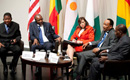
The elected presidents of four West African nations, appearing at USIP, called for consolidating democratic advances in their countries after what for most has been a debilitating period of conflict, dictatorship and political struggle. | Read about the USIP event with the presidents of Benin, Niger, Cote D'Ivoire and Guinea http://click.newsletters.usip.org/?qs=994cde0d6eadcbbd7851f53682e4a058f03abb0dfd7410c974c45c8c6b817192

State Dept publishes official history of US in Southern Africa (1969-76)!


Who even knew the State Department published these types of things--I sure didn't, until today!  I will definitely file this one away to refer to for a paper in the future.  It's 2.4mb and 790 pages (thank God for the "find" function). 

Africa: Office of the Historian, Bureau of Public Affairs Release of Foreign Relations, 1969-1976, Volume XXVIII
Office of the Spokesperson
Washington, DC
July 26, 2011

The Department of State released today Foreign Relations of the United States, 1969–1976, Volume XXVIII, Southern Africa. Additional volumes covering Sub-Saharan Africa and North Africa, 1969–1972, are available on the Department of State website. Documentation on U.S. policy towards North Africa, 1973–1976, is scheduled for future publication on the Department of State website.

The volume contains four chapters (entitled Regional Issues, Portuguese Africa, Angola, and Independence Negotiations), each documenting a segment of U.S. policy toward Southern Africa during the presidencies of Richard Nixon and Gerald Ford. The documentation reveals that both presidents pursued policies designed to maintain stability in the region and to avoid domestic and international criticism of U.S. ties to the white minority regimes in South Africa and Southern Rhodesia.

The chapter on Regional Issues covers South Africa, which both administrations viewed as a bulwark against Communist expansion in the region. The documents illustrate the tensions between the Nixon administration and the Congressional Black Caucus and between the administration and the Department of State’s Bureau of African Affairs in dealing with South Africa’s apartheid regime. They also show a preference by Nixon and Henry Kissinger to avoid direct involvement in the growing unrest.

The chapter on Portuguese Africa reflects the evolution of U.S. involvement in Angola and Mozambique. Anxious to avoid alienating a key NATO partner, the Nixon administration sought to persuade the Portuguese Government to address the grievances of the black nationalist movements, while quietly granting limited assistance to the Revolutionary Government of Angola in Exile (GRAE) and National Front for the Liberation of Angola (FNLA) leader Holden Roberto. U.S. involvement increased dramatically in January 1975, when Portugal granted independence to its African colonies. Concerns about Soviet expansion and Cuban involvement led the United States to provide covert support to anti-Communist forces in Angola.

The chapter on Angola chronicles the continuation of U.S. support to anti-Communist forces after the Portuguese departed in November 1975. Despite substantial assistance and support from South Africa, Zaire, Zambia, and others, the U.S. was unable to turn the tide in Angola. Congressional passage of the Tunney Amendment in December 1975 cut off aid to Angola and effectively ended U.S. support.

The chapter on independence negotiations chronicles Kissinger’s effort to broker a negotiated settlement to the conflicts in Namibia and Southern Rhodesia.

This volume was compiled and edited by Myra Burton. The volume and this press release are available on the Office of the Historian website at http://www.history.state.gov/historicaldocuments/frus1969-76v28
Copies of the volume will be available for purchase from the U.S. Government Printing Office online at http://bookstore.gpo.gov/

Tuesday, July 26, 2011

Notes on Barcott's: It Happened on the Way to War

I am working on a book review of Rye Barcott's excellent It Happened On the Way to War: A Marine's Path to Peace Following are my notes on the first two-thirds of the book. 


My thoughts after meeting Rye Barcott.
FAO Africa Recommended Reading List
ATTENTION:  IS THE LIST ABOVE TOO OVERWHELMING?  I'VE PUT TOGETHER  A STARTER READING LIST HERE.

 It Happened on the Way to War: A Marine’s Path to Peace Review

p. 27
“Never doubt that a small group of thoughtful, committed citizens can change the world.  Indeed, it’s the only thing that ever has.”  -Margaret Mead, legendary anthropologist and one of Rye’s mother’s favorite quotes.

p. 28
Rye relates his moment of spiritual realization when “the force swept me into its embrace”  following his near-drowning episode during his adolescence.

p. 30
“Reach out to a bunch of people and eventually a few will give a damn.” Ted Lord’s advice to Rye as he seeks a way to spend the summer in Rwanda

p. 33
Rye related the travails of networking:  “I had spent 3 hours for a 10-second offer of an introduction that might be able to take me where I needed to go.”

p.36
Rye’s Rwanda plans are scrapped and professor Jennifer Coffman suggests Kibera.  Rye’s begins anew searching for the next 5% who gave a damn.

CHAPTER TWO FIST BUMP (BIG GOTA)
p. 38
“Did poverty alone make people less trustworthy” Rye ponders after conversation with Kenyan businessman on flight to Nairobi.

p. 40
Kenyan couple can’t comprehend that someone would only have one child (BIG cultural difference).

p. 41
Rye gets his Kenyan nickname: Omosh, based on the time of day he was born from Elizabeth and Oluoch. 

The Challenge of Nationhood by Tom Mboya

p. 42
In the book, Mboya points out that: “the second generation leadership would inherit a framework that is so dependent on personality that it cannot survive the person on whom it depended.  This could bring with it a phases of deep political problems—tribalism, personality cults, foreign intervention and even military coup.  (march 1960, six years after Kenya’s independence.  4 months later he was assassinated. 

p. 45 “Sheng” is the language of the youth in the slums, an extreme slang of Swahili

p. 46 The railroad tracks separate Kibera from Nairobi (part of the Kenya-Uganda railway).  VERY poorly maintained. 

p. 47  The thumbs-up is a sign of the NDP  and ‘mzungu’ means white person.

p. 48  Rye describes the sounds of life inside Dan’s compound in Kibera.  These sounds could be the start of a movie…or even combine into a song for the movie:  boy’s shout, dog’s bark, man’s cough, door slaps shut, water splashes, broom whisks, pickaxes ping, stereos rattle music etc…

p. 53 While it seems a little callous that Rye is so hesitant to share/donate his money to someone like Baba Chris (even though it’s only $7)…it’s also important to note that mids don’t get paid anything at all (or at the most $50 a month).

Monday, July 25, 2011

"Blood diamond" regulation system broken: The recent regulatory approval of Zimbabwean diamonds for sale reveals deep flaws in the system

"Blood diamond" regulation system broken: The recent regulatory approval of Zimbabwean diamonds for sale reveals deep flaws in the system.

I wish I knew more about the diamond business, but even in my near total ignorance of the subject I can tell you that this is a very interesting article. 

A famine of food and international politics in East Africa

Daniel Howden: This famine is a failure of politics, not of generosity

After 9/11 it no longer mattered to the West what happened to the Somalis as long as their suffering was contained and radical elements neutralised

Preach it Daniel!  If want to read more about the famine (and international failures in response) he mentions back in the 90's check out The Zanzibar Chest by Aiden Hartley.  Now compare the points made in Daniel's article with France's Agriculture Minister "Monsieur Je miss the point and root of the crisis here'  Le Maire statements in the article below:

The world has "failed to ensure food security", France's agriculture minister has said at the UN food agency crisis talks on East Africa's drought. "If we don't take the necessary measures, famine will be the scandal of this century," AFP news agency quotes Bruno Le Maire as saying in Rome.


LINKS:


CNAS Next Gen Leaders Program and 4 African Presidents parlent à USIP ce jeudi

CNAS Next Gen Leaders Program and 4 African Presidents parlent à USIP ce jeudi

CNAS Launches Third Annual Next Generation National Security Leaders Program: All eligible candidates are invited to apply at

Check out their website as this is a cool program and one which offers you access and exposure to DC's brightest.  Granted these smug bastards they didn't select me for it when I applied last year, so I have reason to doubt its selection process but perhaps you, my young (32 years old is the age cap for this program) readers, stand a better chance.  I would apply again this year but I am bitter and wanted to give everyone else a shot and I want to hold it over their heads one day when I am the SDO/DATT in South Africa and they need my help to set up a safari or something  will be leaving the DC area in December. 

USIP hosts 4 Francophone Presidents this Thursday
Four Francophone states in West Africa have recently held elections.  In three, new presidents have taken office in processes that followed protracted periods of conflict and disputed rule; in Benin, a reelected incumbent has continued a democratic tradition of 20 years' standing.  Despite the fact that the outcomes of some of these elections have been disputed, they nevertheless represent steps toward strengthening democracy in the region. 

The U.S. Institute of Peace is pleased to host the presidents of these four countries at 2:00 pm on Thursday, July 28.   
This event will feature the following speakers:

Boni Yayi
President of Benin

Alpha Conde
President of Guinea

Issoufou Mahamadou
President of Niger

Alassane Ouattara
President of Cote d'Ivoire

Webcast: You may participate in this event in two ways. You can register to attend the event, or you may watch the live webcast beginning at 2:00 pm EST on July 28, 2011 at www.usip.org/webcast . Please note this webcast will be spoken in part French, and will not feature translation

LINKS:


Kenya's government opens its robes and the State Dept shows up

In case you didn't know, Ushahidi (meaning 'testimony' in Swahili) is the company behind all those cool crowd-sourcing maps that pop up on the news whenever the latest crisis occurs (a VERY simplified explanation).   Spend some time on their website and you will get a glimpse of what the future will look like.


July 22, 2011

State Department Coordinator for Cyber Issues, Chris Painter, will be traveling to Kenya for the East Africa Workshop on Cyberspace Security, to be held in Nairobi July 25 to July 27. Coordinator Painter will be leading the U.S. Interagency Delegation and will provide keynote remarks. Kenyan Minister of Communications, Samuel L. Poghisio, and U.S. Ambassador to Kenya, Scott Gration, will also provide keynote remarks.

As the internet, networked systems, and the use of mobile phones expand throughout sub-Saharan Africa, nations are grappling with multiplying cyber threats ranging from transnational crime groups to terrorists. This workshop, a partnership between the U.S. and Kenyan governments, will address broad issues on cyber crime and cyber security while focusing discussions on issues of specific interest to East Africa, such as mobile cellular security and the development of national computer emergency response teams or CERTs.

The conference will be attended by government officials from the five East African Community states: Burundi, Kenya, Rwanda, Tanzania, and Uganda. U.S. and African private sector and academic experts will also contribute their thoughts and insights to the discussion.


LINKS:


Friday, July 22, 2011

Navy-Capitol Hill Workshop and CCA US-Africa Business Summit

This is a pretty cool ('pretty' because it costs $1500) 4-day primer on all things Capitol Hill for the young naval officer.  Many applicable naval staffs will foot the bill for this if you know about it!  I've been working in the PGON for more than a year though and I just found out about it today, so feel free to spread the good word.  I'd also be interested to hear comments from any FUUO readers that have attended the workshop.

The Government Affairs Institute, Georgetown University, provides opportunities for Department of Navy (DON) employees to receive a first-hand understanding not only of congressional process and procedure, but also the unique culture surrounding the United States Congress. Over the four days, participants will hear from, and be afforded the opportunity to ask questions of, Members of Congress, congressional staff, academic observers, interest group representatives, news media representatives and DON Legislative Liaison staff.


The Corporate Council on Africa is hosting their 8th biennial US-Africa Business Summit.  Have any readers been to one previously?  I am looking forward to Plenary III which has a maritime DOD focus!

LINKS:


Wednesday, July 20, 2011

Foreign Area Officer (FAO) Reading list updated!

Foreign Area Officer (FAO) Reading list updated!

I have updated my reading list page: http://fuuo.blogspot.com/p/the-fao-africa-book-list.html


Please let me know if you have suggestions that I should add.  My list is still very weak on South American and Europe. 

I am also happy to link to any reviews you might have for any of these books. 

International Relations through a 20mm lens

As a photography enthusiast, I found Wide Aperture's latest blog post to be a phenomenal one (Wide Aperture is a photography subset of the online news magazine Current Intelligence).  The article doesn't directly pertain to Africa but it does speak to the power of the captured image to offer commentary and insight into a country and its issues.  Photographs can offer texture and context to circumstances that are difficult to address with the written word.  In the article the editors address this idea of photographic texture and context in Hannes Opelz's latest work, "The Dream of Occupation", a photo essay about the West Bank. 

What are your favorites blogs and websites and photography in Africa?

LINKS:
http://www.currentintelligence.net/wideaperture/2011/7/14/dreams-of-occupation.html

http://www.20mm.ch/the_dream_of_occupation/

http://www.currentintelligence.net/wideaperture