FAO Quotables

"But being right, even morally right, isn't everything. It is also important to be competent, to be consistent, and to be knowledgeable. It's important for your soldiers and diplomats to speak the language of the people you want to influence. It's important to understand the ethnic and tribal divisions of the place you hope to assist."
-Anne Applebaum

Showing posts with label aviation. Show all posts

Thursday, April 12, 2018

More Than Flight Hours: Building a Lasting Aviation Safety Culture


DISCLAIMER: I caveat all this with the fact I got out of the naval aviation business when I lat-transferred to Foreign Area Officer back in 2011 so I am not current on the latest developments in naval aviation safety. These are my personal views and not that of the US Navy or DoD.

BUT I did spend three years at the HSC Wing (80 H-60s and 3000 personnel) Safety Officer in San Diego and took to heart the importance of safety programs during my tour there. It's appropriate that the genesis for my article--a Military Times article this week titled "The death toll for rising aviation accidents: 133 troops killed in five years," included a photo collage of those who've lost their lives this past year because all too often the human cost can get lost in the sterile analysis of flight hours and numbers. These aviators and aircrew had spouses and children and loved ones who carry on with a hole in their hearts and lives that will never be filled.

During my tour as the Wing Safety Officer I had the heart-breaking task of investigating a class-A mishap for my former squadron. I was woken with a call from our Commodore one night telling me that a helicopter had crashed. My throat caught immediately and then my heart crashed when he told me it was my old squadron. He asked me to meet with the search and rescue boat at the Coast Guard station and I quickly put on my uniform and drive from my home in Coronado to the Coast Guard station downtown. I was there when they unloaded the remains and personal items they had recovered. To this day I can't smell JP-5 without being taken back to the pier there. In the early hours of that morning, I had the somber honor of escorting the bodies of my colleagues in the ambulance to the morgue at Balboa Hospital. I didn't want them to be alone in this journey and I thought it important that they be accompanied by someone who knew their face, their smile, their laughter.

I share these details to underscore that there's not an aviator out there who doesn't hear about an aircraft crashing and immediately stop and hope and pray that it's not someone they know.

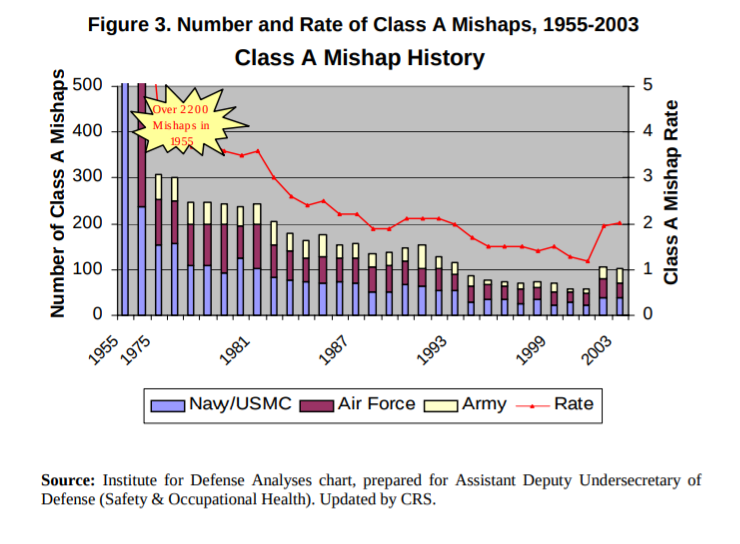
And I'd venture to guess that there's very few of us who haven't been to at least one funeral or service during our careers. Aviation safety is something that should be important and personal to everyone in our field. We owe it to one another to take it seriously and with the gravity it deserves. Aviation safety has come a long way since the pre-NATOPS, pre-Safety Center pioneering days and to its credit, mishaps have plunged since the 1950s. While today our Naval Safety Center today takes its job seriously, aviation safety can't happen at the headquarters level. Aviation safety starts with the individual.

Me.

You.

It was one of these individuals that saved my life during a series of unaided night landings on a small boy during my fleet tour. Not yet an aircraft commander and on approach and at the controls during a near zero-illum night, I experienced vertigo and thought I was coming over the ship's deck when I was actually several hundred feet short. Had not AW2 Baecker, one of my aircrewmen in the back, not felt the ocean spray at under ten feet coming into the cabin and screamed for POWER, POWER, POWER, I would have been one of those faces in a collage. Had it not been for her, I wouldn't never have met my wife, never had 5 beautiful children to come home to every day. My entire future and that of my crew, would have vanished at the bottom of the ocean. Were it not for AW2 Baecker, I would have flown the helicopter right into the blackened sea.

Building an enterprise-wide safety culture is a deadly serious endeavor.


I've never shared all of these things publicly but I do now because I believe that it's important that articles like this are shared and discussed because a safety culture doesn't exist in a vacuum and productive, robust safety cultures don't happen by accident. When possible trends are identified, it's important to dig deeper and work to improve across our services. In keeping with this spirit I'd say this article is a worthy starting point if you want to analyze possible systematic safety issues within DoD aviation. The article focuses on the role of diminished flight hours which I believe could play a part in the rise in mishaps but I'd also point out that the "swiss-cheese" nature of aviation mishaps means that even wider trends seldom come down to one simple root cause (and with increasingly sophisticated aircraft and peripheral equipment, just scratching some paint can give push you into the Class C threshold). Unfortunately, in some cases, despite rigorous and exhaustive analysis and investigation, we never know exactly why a mishap occurred.

Following is a brief (admittedly Navy-centric) summary of items that our service safety centers could coordinate on in their analyses.

1. HAZREPS (Hazard Reports) and equivalent reporting across the services (and sharing of information).

2. Service-variable attrition standards throughout flight school. Put simply, how many downs before you fail out? How has this changed over the years? An OVERLY simplified explanation is that these standards tend to change over the years driven by service manning requirements.

3. Human Factors. The majority of aviation mishaps come down to this at some point in the chain of events. This is where one might find useful trends. I don't believe services are sharing this information in a central repository at this time.

4. Squadron safety culture. While "safety culture" is a nebulous terms, there are methods to at least begin to quantify this:
  • Are squadrons getting the baseline surveys done (e.g., CSA, MCAS, NSC surveys, Safety Standowns, Human Factors Councils, Enlisted Safety Committee meetings, anymouse submissions) on a regular basis?
  • Are Commanding Officers debriefing and addressing any noted issues in a timely and transparent nature?
  • Are squadrons maximizing simulator use when flight hours are reduced?
  • Are squadron writing safety articles, submitting NATOPS changes, making NAMDRP/JDRS submissions?
  • Are squadrons ensuring all required ORM coursework is complete? 

NOTE: here's some good background on safety culture here:    http://www.dtic.mil/dtic/tr/fulltext/u2/a490843.pdf

5. More rigorous and systematic Class C analysis is necessary to determine if their rise are actually "lagging indicators" of wider problems or not.

6. Intra-service best practices. This is likely an area where the services can improve. Yes, each service has specific cultures, missions, and standards that make quantitative analysis difficult but that doesn't mean we shouldn't strive for this. For example as a starting point:
  • Do services share best safety practices?
  • Is there a method to share this type of information?
  • Does one service have a better method for the equivalent of NATOPS checks? 

This is an admittedly difficult goal because it requires a level of trust between services and requires a willingness to highlight shortcomings and failures.

Further references:
2003 CRS Report on Military Aviation Safety: https://www.everycrsreport.com/files/20031125_RL31571_1e95b1b93a0fcdee4874121b47fa34a65fcc4c04.pdf

Monday, October 12, 2015

What I Read Last Week: Lonely Rats, the Libya Novel You Never Knew About, BMX in Mada, Blind Hikers and an Age 18 List for Your Kids

The War on Loneliness
A great post related to the exploding heroin addiction problem in the United States.  Turns out addiction is less pronounced and powerful when people are in community.  People crave relationships...we were made for them.

A LIBYAN NOVEL YOU SHOULD READ

It was only recently translated from Italian into English.  It's billed as a multi-generational fictional history of Libya beginning from the 1900s in the vein of the epic The Cairo Trilogy: Palace Walk, Palace of Desire, Sugar Street --one of my favorites.  I just started it and am adding it to my 2015 Reading List.  

A Stage Across the Sea An unjustly-neglected Libyan novelist captured the twisted logic of colonialism, past and present. 
In which a very intelligent writer named Ursula Lindsey lays out exactly why The Confines of the Shadow is such an important book.

DADA | The Malagasy Trialist
Cool little video about a Malagasy stunt bike rider named Dada up in Nosy Be.

The blind hiker who takes on the wilderness
Don't need to say much more than the title.   The hiker described has started a cool charity called The Far Sight Foundation .  He was the first blink hiker to complete the Appalachian Trail--check out his website.

CASH FAMILY “AGE 18 LIST” FOR OUR KIDS
A great post from the Chaplain for Mercy Ships that is here in Madagascar right now.  In it he offers a template to write out your hopes for your children by the time they turn 18.  Working backward from that then gives you an ability to build up those characteristics in your children.


Monday, February 4, 2013

Beautiful writing from Beryl Markham in "West with the Night"

I just finished Beryl Markham's incredible and astounding West with the Night.  

First, as a former pilot myself, I am astounded and in awe of the pioneering pilots of the 1920's and 30's in Africa.  They were all equal parts brave and reckless as they flew across uncharted land and skies for which no map (as we know them today) existed--flying aircraft equipped with only a compass.
Markham in a conversation with a young man about flying:
When you fly,’ the young man said, ‘you get a feeling of possession that you couldn’t have if you owned all of Africa. You feel that everything you see belongs to you — all the pieces are put together, and the whole is yours; not that you want it, but because, when you’re alone in a plane, there’s no one to share it. It’s there and it’s yours. It makes you feel bigger than you are — closer to being something you’ve sensed you might be capable of, but never had the courage to seriously imagine.’ (KL 1857)


I am even more impressed with Markham's writing.  As I was reading West I kept thinking that her writing was on par with Hemingway and F. Scott (although she only ever wrote this one novel) and then I came across this gem from one of Ernest's letters to a contemporary:


Did you read Beryl Markham's book, "West with the Night"? I knew her fairly well in Africa and never would have suspected that she could and would put pen to paper except to write in her flyer's log book. As it is, she has written so well, and marvelously well, that I was completely ashamed of myself as a writer. I felt that I was simply a carpenter with words, picking up whatever was furnished on the job and some times making an okay pig pen. But this girl who is, to my knowledge, very unpleasant,... can write rings around all of us who consider ourselves as writers. The only parts of it that I know about personally, on account of having been there at the time and heard the other people's stories, are absolutely true. So, you have to take as truth the early stuff about when she was a child which is absolutely superb. She omits some very fantastic stuff which I know about which would destroy much of the character of the heroine; but what is that anyhow in writing? I wish you would get it and read it because it is really a bloody, wonderful book.


I couldn't agree more with Hemingway--this was an incredible and beautiful book-- I place it in my all time TOP 5 best books written.  Markham is a master at the extraordinarily difficult task of capturing and retelling memories and events.  Her excellence shines through, however, in capturing past feelings and sentiments.


Markham on the soul of Africa:
Africa is never the same to anyone who leaves it and returns again.  It is not a land of change, but it is a land of moods and its moods are numberless.  It is not fickle, but because it has mothered not only men, but races, and cradled not only cities, but civilizations--and seen them die, and seen new ones born again--Africa can be dispassionate, warm, or cynical, replete with the weariness of too much wisdom. 


Markham on Africa today and tomorrow:
Today Africa may seem to be that ever-promised land, almost achieved; but tomorrow it may be a dark land again, drawn into itself, contemptuous, and impatient with the futility of eager men who have scrambled over it since the experiment of Eden. In the family of continents, Africa is the silent, the brooding sister, courted for centuries by knight-errant empires — rejecting them one by one and severally, because she is too sage and a little bored with the importunity of it all.


Markham on retreading one's footsteps, i.e.,  'the second time around':
Seeing it again could not be living it again.  You can always rediscover an old path and wander over it, but the best you can then is to say, 'Ah, yes, I know this turning!' --or remind yourself that, while you remember that unforgettable valley, the valley no longer remember you.  

Markham on remembering and silence:

There is the silence of emptiness, the silence of fear, the silence of doubt. There is a certain silence that can emanate from a lifeless object as from a chair lately used, or from a piano with old dust upon its keys, or from anything that has answered to the need of a man, for pleasure or for work. This kind of silence can speak. Its voice may be melancholy, but it is not always so; for the chair may have been left by a laughing child or the last notes of the piano may have been raucous and gay. Whatever the mood or the circumstance, the essence of its quality may linger in the silence that follows. It is a soundless echo. (KL 603-7)


Markham on lions:
‘Lions are more intelligent than some men,’ he said, ‘and more courageous than most. A lion will fight for what he has and for what he needs; he is contemptuous of cowards and wary of his equals. But he is not afraid. You can always trust a lion to be exactly what he is — and never anything else.’  (KL 705)


Markham on writing:
Silence is never so impenetrable as when the whisper of steel on paper strives to pierce it. I sit in a labyrinth of solitude jabbing at its bulwarks with the point of a pen — jabbing, jabbing. (KL 1764)

Markham on life in Africa:
In Africa people learn to serve each other. They live on credit balances of little favours that they give and may, one day, ask to have returned. In any country almost empty of men, ‘love thy neighbour’ is less a pious injunction than a rule for survival. If you meet one in trouble, you stop — another time he may stop for you. (KL 1832)


Markham on loneliness:
You can live a lifetime and, at the end of it, know more about other people than you know about yourself. You learn to watch other people, but you never watch yourself because you strive against loneliness. If you read a book, or shuffle a deck of cards, or care for a dog, you are avoiding yourself. The abhorrence of loneliness is as natural as wanting to live at all. If it were otherwise, men would never have bothered to make an alphabet, nor to have fashioned words out of what were only animal sounds, nor to have crossed continents — each man to see what the other looked like. (KL 3498)


More on two documentaries/movies made about Markham:

http://www.nytimes.com/1988/05/13/arts/tv-weekend-beryl-markham-a-wonder-in-kenya.html
http://www.nytimes.com/1986/10/08/movies/tv-reviews-world-without-walls-about-beryl-markham.html

Other great books on Africa: