Thoughts on French's Thoughts on Rice or The Geography of Intervention
First of all, you should read French's recent Atlantic article on Susan Rice's history with the continent. You would also be well-served to
follow him on twitter.
Howard French's article is linked here:
What Susan Rice Has Meant for U.S. Policy in Sub-Saharan Africa
My comments:
This
is a timely and well put summary of issues to consider concerning Susan
Rice. Hopefully there's a sharp pro-staffer on one of the
Congressional committees that can push the questions outlined here to
the right Congressman.
Perhaps the greatest obstacle to
"help [ing] Africa consolidate its recent gains and move forward into an era of greater prosperity and representative government" is that assumption that we can help "Africa" as a whole.
I doubt
that French meant it in this way (no doubt more a product of word limit
constraints) but the danger here is that some neophytes to the continent
might take it THAT way.
I don't think the U.S. will ever have a policy towards 'africa' but
instead must decide the strategic partners to work with on the
continent (bilat) or the broader regional institutions. There is of
course danger here in neglecting certain nations.
Then of course the US must determine how thick (i.e., overlapping or
close to it) its lines of efforts will be (DOS, DOS and private
capital)--I say this because it would be great for this to be a holistic
effort but effecting that is likely too formidable an obstacle--so
maybe if the lines of effort are 'thick' enough, the stovepipes can
merge (a little at least).
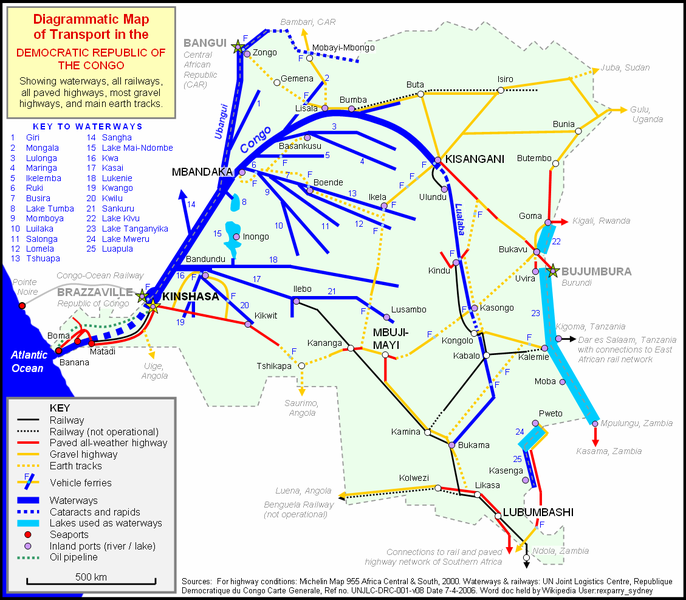
I would be curious to hear from French how the US could/would/should
intervene in the Congo crisis to "finally establish control over all of
its territory and begin delivering services to its people for the first
time in history." This would require a Marshall-esque economic input
and an Eisenhower-esque infrastructure project for a nation 1/4 the size
of the US with only about 1400 (!) miles of all weather paved roads (see second picture below).
Not saying that it would not be worth it, just saying that (for once) the U.S.
should consider what it's getting into so it can make good on its
promises and follow through.
French's last sentiment:
"The other requires treating African
democracies as our real friends, matching our diplomacy for once with
our rhetoric and values" is a nice one to which we should aspire,
however, we should probably add a fair amount of qualifiers to what
constitutes a democracy for our purposes.
An added note: When I first started studying the continent, my gut
reaction to China's blind (*gasp) capitalism that placed money ahead of
human rights was outrage. My outrage has since been tempered when I
consider that while U.S human rights policies/requirements may "send a
message" to dictators or other derelict authoritarians, it also "sends a
message" to the long-suffering inhabitants of that state: we don't
care about you, the common citizen--we care about your institutions
(which you may only understand obliquely at the village level) and
'sending messages.'
On more thing: Hats off to French for pointing out Rice's malfeasance
concerning the genocide in Rwanda--the administration's actions before,
during and after were awful. The scheming and blocking in the UN alone
sicken me to my stomach even today.
Want to read more about the
geography of intervention? See my post
here about the U.S. response to the MASS RAPES carried out in the DRC in the summer of 2010.
 |
| A "road" in the DRC |