FAO Quotables

"But being right, even morally right, isn't everything. It is also important to be competent, to be consistent, and to be knowledgeable. It's important for your soldiers and diplomats to speak the language of the people you want to influence. It's important to understand the ethnic and tribal divisions of the place you hope to assist."
-Anne Applebaum

Showing posts with label congo. Show all posts

Saturday, July 7, 2018

Kruse's Keys: Read "Dancing in the Glory of Monsters" to Learn About the Most Brutal War You've Never Heard Of (DRC)


Horseshoes and Hand Grenade History of DRC:
King Leopold II uses Congo as his own private playground, factory, and torture chamber until the Belgian government wakes up and takes it away from him. They create the Belgian Congo which they run for the next 50 years until Congolese independence in 1960. Rising nationalism combined with the fact that Belgium finally realized they couldn’t administer a country three times the size of Texas. Patrice Lumumba becomes Prime Minister until 1965 when, amidst the Cold War, the US conspires to support Mobutu in a coup to overthrow Soviet sympathizer Lumumba. From 1965 into the 90s, Mobutu Sese Seko rules the country that he renames Zaire. Eventually, in 1996 Laurent Kabila heads up a multi-national, multi-ethnic coalition of forces and takes Kinshasa from a fleeing Mobutu by 1997. Kabila promptly renames the country the DRC. Kabila proves ineffective and a Ugandan-backed rebel movement starts the next year led by warlord Jean-Pierre Bemba. Eventually this second war devolves into a struggle between six bordering countries. In 2001 Kabila is assassinated and succeeded by his son Joseph. By 2003 the war ends after much death and destruction. Since then Joseph Kabila has continued to rule through several corrupted election cycles. DRC continues to be a country on edge.

NOTE: In this book we are talking about the Democratic Republic of Congo (if you get them used confused just remember: if a country has “democratic” in its name, it likely is anything but. See a great explanation on the two countries here). The DRC is also referred to as “Congo-Kinshasa” (after it’s capital), and Republic of Congo as “Congo-Brazzaville”.

The Story:
I listened to this lengthy journalistic endeavor by writer Jason Stearns while driving home from work to Annapolis during the month of June. In it Stearns attempts to unravel the most complicated conflict that the world never cared about: the two wars in the Congo as he notes: “generally we do not care about a strange war fought by black people somewhere in the middle of africa.” This stands in stark contrast to the conflict in, say Kosovo, by contrast (Ch 23: 21:10).

As Stearns digs deeper and deeper into the wars, however, you are quickly struck by the overwhelming intensity of violence. Eventually it starts to weigh down upon you as you hear tale after graphic tale of rape and murder by every side (and there are many). In particular, the sheer level of sexual violence in incomprehensible as there’s likely no one in the country of 64 million who doesn’t know someone who was raped or assaulted (this Guardian piece notes that 12% of women in the Congo have been raped at least once). The reality of this becomes readily apparent as Stearns cautiously queries a gathered mixed crowd in one village as to whether they know anyone who’s been raped. Their reply: “We’ve all been raped, every single one of us!” (Ch 19: 40:36) The women go on to explain that in most cases, the rapists still live in their community.

Ultimately, it is the absence of justice that marks the conflicts in Congo as distinct from those elsewhere in Africa. There have been no truth and reconciliations commissions or gacaca courts to salve the deep wounds of most in the country. When one couples this festering infection with the lack of any effective state institutions, one is left without much hope. As Stearns observes, with no real state or effective governance, people default to ethnic identification which in turn only amplifies instability and further conflict (Ch 16: 44:31). The book does not end on a hopeful note but this was never the author’s mission. Rather Stearns has sought to reveal an incredibly complex issue that will hopefully inspire action and understanding. As the renowned Congolese singer Koffi Olomide notes in one of his songs: “Lies come up in the elevator, the truth takes the stairs but gets here eventually”

*One of my Reading Around the Continent books--the full list is here.
See our 20182017, 2016, 2015 and 2014 Reading Lists.

Key Quotes:
  • “Lies come up in the elevator, the truth takes the stairs but gets here eventually” -Congolese singer (and assaulter extraordinaire) Koffi Olomide (Ch 1: 25:36)
  • Laurent Kabila, stereotypical Congolese big man. “Who has not been Mobutists in this country? We saw you all, dancing in the glory of the monster.” (Ch 2: 18:25)
  • “Where elephants fight, the grass is trampled” Common excuse used by those who had committed atrocities in Rwandan genocide. In this case it was used by Rwandan leader Rwarakabije, who is today a Rwandan military leader responsible for much of the murdering. This proverb was a refrain commonly used by many leaders who perpetrated evil. You can read more about him today in this 2009 New Yorker Piece. (Ch 3: 54:09)
  • “Africa has the shape of a pistol and Congo is its trigger.” -Frantz Fanon (Ch 5: 00:16)
  • “We’ve all been raped, every single one of us!” (Ch 19: 40:36)
  • “Generally we do not care about a strange war fought by black people somewhere in the middle of africa.” As opposed to say Kosovo (Ch 23: 21:10) 
Key Takeaways:
  • Lack of institutions large part of conflict in Congo: Failure to ever build strong institutions = many actors compete for power and resources in this vacuum. There were 40 different Congolese armed groups at height of war with 9 different african states deploying troops in eastern congo. Don’t simplify for the sake of theoretical clarity. (Chapter 1: 12:21)
  • International attention is stymied by the complexity and breadth of the conflict: No easy way to describe the war so despite its staggering statistics, it gets lost in the momentary headlines. There’s no easy villains. “War of the ordinary person” 20 different rebel groups. (Ch 2: 5:24-6:00)
  • The African World War: The War in the Congo was not a civil war but rather it was African leaders against Mobutu in a regional conflict...in effect Africa’s World War. (Ch 5:28:04)
  • Zimbabwe provided money, Eritrea provided boats, ethiopia and tanzania provided military advisors. (Ch 5: 31:13). Most important front of Congo war was being fought by foreign troops on both sides (Ch 20: 19:01)
  • On the efficacy of using child soldiers: Child soldiers were used as vanguard special forces because they lacked the judgment of olders soldiers who knew to fear death and who would only accept a limited amount of risk. (Ch 12: 25:33)
  • How foreign aid impedes progress: Development of rule of law and governance in the Congo is stymied by foreign aid which takes over the reins of tasks and responsibilities which should fall to a functioning government. (Ch 23: 15:44)
  • The unexamined/unrestrained global economy as a driver of instability and violence: Link between Sony Playstation and coltan in the Congo (Ch 20: 41:02)

Key References (for further study)
My review of "A Bend in the River" is here.


NY Times 2011 Book Review of "Dancing"
WaPo Review of "Dancing"
African Arguments 2011 Review of "Dancing"
Telegraph 2011 Review of "Dancing"
New Republic Review of "Dancing"
Foreign Affairs Capsule Review of "Dancing"
Lonely Planet Founder Review of "Dancing"
The Life After Fifteen years after the genocide in Rwanda, the reconciliation defies expectations (2009)
Inside Africa's "Playstation War" (2008 Wired)
BBC Country Snapshot
A Tale of Two Congos blog
Pulitzer Center Report on "Plight of the Banyamulenge"


  • Failure to ever build strong institutions = many actors compete for power and resources in this vacuum. There were 40 different Congolese armed groups at height of war with 9 different african states deploying troops in eastern congo. Don’t simplify for the sake of theoretical clarity. (Chapter 1: 12:21)
  • Dan Gertler made fortune off illicit sales of mining rights (US targets Israeli businessman Dan Gertler with fresh sanctions) by exploiting his personal relationship with President Kabila (Chapter 1: 18:17)
  • No easy way to describe the war so despite its staggering statistics, it gets lost in the momentary headlines. There’s no easy villains. “War of the ordinary person” 20 different rebel groups. (Ch 2: 5:24-6:00)
  • In the Congo, the power of the state has been eroded over centuries. In 1885 King Leopold claimed the space as the Congo Free State until 1908 when he turned the country over to the Belgian government. (Ch 2: 9:57-11:00)
  • Good history of Tutsi and Hutu in Rwanda/Eastern Congo (Ch 3: 25:55)
  • Humanitarian aftermath of Rwandan genocide in effect whitewashed much of the crimes but erasing good and evil and recasting all as vicitims. (Ch 4: 24:07)
  • The War in the Congo was not a civil war but rather it was African leaders against Mobutu in a regional conflict...in effect Africa’s World War. (Ch 5:28:04)
  • Zimbabwe provided money, Eritreat provided boats, ethiopia and tanzania provided military advisors. (Ch 5: 31:13)
  • Role and history of the Banyamulenge, a persecuted minority discussed in depth and a key group in the conflict. You can read more on it here. (Ch 6: 09:19)
  • It’s difficult to convey how the mass killings could have occurred but its equally difficult to convey the generational and societal history of killing on both sides. (Ch 7: 06:21).
  • 1937 Belgians brought in tens of thousands of Rwandan workers into Kivu due to their “reputation” as hard working and later morphed to another 100,000..this was followed by another wave around Rwandan independence number (due to unrest) which ultimately resulted in 335,000 living in the Congo as part of the Goma elite in Massisi (as much as 70% of the population there). (Ch 7: 08:18)
  • Che Guevara eventually gave up in Congo with his disillusionment with Kabila (Ch 8: 10:12)
  • Laurent Kabila accidental leader of AFDL movement (Ch 8: 26:25)
  • AFDL troops took on names of famous bad guys...even today some captured villagers describe AFDL leaders named Rambo or Qadaffi. (Ch 10:40:10)
  • Congolese army problem was how to reform it structurally but how to reform its corrupt leaders (Ch 10: 52: 36).
  • Child soldiers were used as vanguard special forces because they lacked the judgment of olders soldiers who knew to fear death and who would only accept a limited amount of risk. (Ch 12: 25:33)
  • Mwenze Kongolo, a former bail officer from Philly became Kabila’s Minister of Interior. (Ch 14: 26:48)
  • Big obstacle to progress in Congo is the ethnic identification which is exclusive by nature and which is only strong because the state is absent (Ch 16: 44:31)
  • “We’ve all been raped, every single one of us!” (Ch 19: 40:36)
  • Since 1998 over 200K women raped in Congo, 39% of the total population! (Ch 19: 40:52)
  • Most important front of Congo war was being fought by foreign troops on both sides (Ch 20: 19:01)
  • War corrupted anything good in Kabila...he became consumed by it (Ch 20: 49:38)
  • Link between Sony Playstation and coltan in the Congo (Ch 20: 41:02)
  • Development of rule of law and governance in the Congo is stymied by foreign aid which takes over the reins of tasks and responsibilities which should fall to a functioning government. (Ch 23: 15:44)
  • Congo is an outlier because they haven’t had tribunals to bring some measure of justice to victims (Ch 23: 19:29)

Thursday, December 6, 2012

Thoughts on French's Thoughts on Rice or The Geography of Intervention

Thoughts on French's Thoughts on Rice or The Geography of Intervention

First of all, you should read French's recent Atlantic article on Susan Rice's history with the continent.  You would also be well-served to follow him on twitter.

Howard French's article is linked here:
What Susan Rice Has Meant for U.S. Policy in Sub-Saharan Africa

My comments:
This is a timely and well put summary of issues to consider concerning Susan Rice. Hopefully there's a sharp pro-staffer on one of the Congressional committees that can push the questions outlined here to the right Congressman.

Perhaps the greatest obstacle to "help [ing] Africa consolidate its recent gains and move forward into an era of greater prosperity and representative government" is that assumption that we can help "Africa" as a whole.

I doubt that French meant it in this way (no doubt more a product of word limit constraints) but the danger here is that some neophytes to the continent might take it THAT way.

I don't think the U.S. will ever have a policy towards 'africa' but instead must decide the strategic partners to work with on the continent (bilat) or the broader regional institutions. There is of course danger here in neglecting certain nations.

Then of course the US must determine how thick (i.e., overlapping or close to it) its lines of efforts will be (DOS, DOS and private capital)--I say this because it would be great for this to be a holistic effort but effecting that is likely too formidable an obstacle--so maybe if the lines of effort are 'thick' enough, the stovepipes can merge (a little at least).

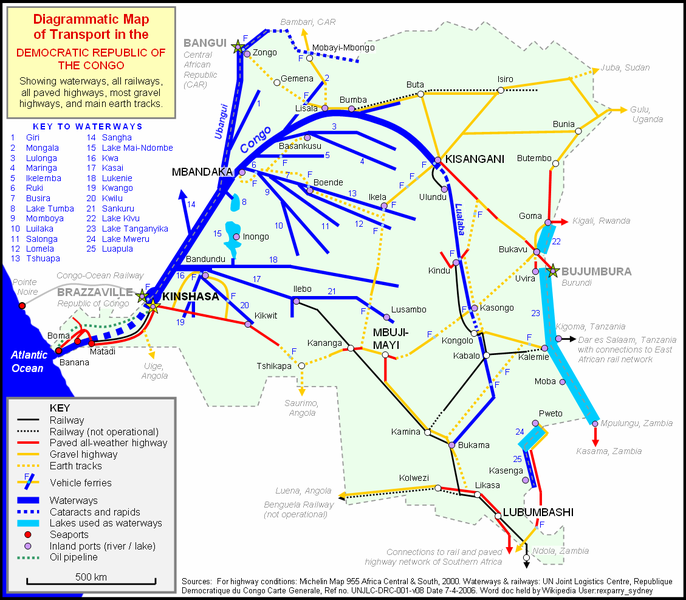
I would be curious to hear from French how the US could/would/should intervene in the Congo crisis to "finally establish control over all of its territory and begin delivering services to its people for the first time in history." This would require a Marshall-esque economic input and an Eisenhower-esque infrastructure project for a nation 1/4 the size of the US with only about 1400 (!) miles of all weather paved roads (see second picture below). Not saying that it would not be worth it, just saying that (for once) the U.S. should consider what it's getting into so it can make good on its promises and follow through.

French's last sentiment: "The other requires treating African democracies as our real friends, matching our diplomacy for once with our rhetoric and values" is a nice one to which we should aspire, however, we should probably add a fair amount of qualifiers to what constitutes a democracy for our purposes.

An added note: When I first started studying the continent, my gut reaction to China's blind (*gasp) capitalism that placed money ahead of human rights was outrage. My outrage has since been tempered when I consider that while U.S human rights policies/requirements may "send a message" to dictators or other derelict authoritarians, it also "sends a message" to the long-suffering inhabitants of that state: we don't care about you, the common citizen--we care about your institutions (which you may only understand obliquely at the village level) and 'sending messages.'

On more thing: Hats off to French for pointing out Rice's malfeasance concerning the genocide in Rwanda--the administration's actions before, during and after were awful. The scheming and blocking in the UN alone sicken me to my stomach even today.

Want to read more about the geography of intervention?  See my post here about the U.S. response to the MASS RAPES carried out in the DRC in the summer of 2010.

A "road" in the DRC


LINKS:
http://www.theatlantic.com/international/archive/2012/12/what-susan-rice-has-meant-for-us-policy-in-sub-saharan-africa/265833/
http://basementgeographer.blogspot.com/2012/04/why-you-cant-drive-across-democratic.html

Wednesday, May 16, 2012

ICow, Mangoes, Bombs in Somalia, and Caesar in the Congo

ICow, Mangoes, Bombs in Somalia, and Caesar in  the Congo

Four worthwhile articles to read.  The first one should be mandatory for every journalist and blogger that writes about Africa.  One may not agree with everything in her article but she makes a plethora of great points that should serve as foundation for further discussion.  My favorite is the last article.


Thursday, March 1, 2012

Read Gettleman's article on "Africa's Dirty Wars"

Gettleman is an incredible writer--I can't believe I haven't read him before!  

Take a few minutes to read his latest article:  Africa’s Dirty Wars from the New York Review of Books today (and follow him on twitter: @gettleman).   His article closes with his observation following a massacre in Niangara:


I walked under the mango trees and into an old house, the field clinic. A young woman sat on an iron cot. She had been fetching water when she was attacked, apparently for no reason. The rebels had pinned her down in the dirt and sliced off her lips. She was twenty-three. Now her mouth will forever be open, like a scream.

He uses a picture from the Richard Mosse's newly released photobook Infra; an examination of the ongoing conflict in the DRC.  


http://www.nybooks.com/articles/archives/2012/mar/08/africas-dirty-wars/?pagination=false

Tuesday, July 12, 2011

For the Metro Ride Home: More Southern Sudans, Cellphone Civil Wars and Stetsons in Africa

Now here would be a great app: one that allows me to download a series of articles to my phone (or IPAD..one day) to read on my metro ride home (the majority of that ride I don't have an internet connection). 

Here are the articles I would read today (and yes, they are biased towards The Atlantic Monthly...sue me; it's just about my favorite magazine, aside from Cooks Illustrated--and don't snicker until you've read CI--if you are a clueless guy whose always wondered why his scrambled eggs or boneless skinless chicken breasts are inedible, CI will be an epiphany!).

This article is certainly a controversial one but definitely contains some ideas that merit debate and discussion.  The author also has a book on the FUUO Book List.  After South Sudan: The Case to Keep Dividing Africa  by G. Pascal Zachary. 


This article is sure to make you feel a twinge of guilt...especially if you are reading it on your smartphone.  I also learned that the mineral 'tungsten' is what makes my cell phone vibrate...who knew!  Is Your Cell Phone Fueling Civil War in Congo? by Erin Banco.  And there's no need to put your cellphone down just yet--the criminals/murderers/thugs/rapists are still going to be the evil scumbags they are with or without a mineral demand signal.


An interesting historical (if biased) look at the US' role throughout the years leading up to July 9th.  Worth the read if for nothing more than the accompanying photo of President Salva Kiir rocking a Stetson with President Bush.  US Played Key Role in Southern Sudan's Long Journey to Independence by Rebecca Hamilton.

Texas In Africa is an informative and solid blog I read every day (and follow on twitter).  I came across the following two articles from his post today:

When I first read Kristof's article I thought it was an okay read.  After I read Bohnstedt's blistering rebuttal to it, I was reminded that I am a neophyte idiot still have much to learn and need to read these fluff pieces with a much more discerning eye.
An African Adventure, and a Revelation by Nicholas Kristof.

If you are interested in Maritime Safety and Security then Information Dissemination should be on your daily read list (it's on mine).  And I am not just saying that because he gave FUUO a shoutout in his post below: http://www.informationdissemination.net/2011/07/river-wars.html


Links:


Tuesday, September 28, 2010

Poet of the Week from the Congo: Jean-Baptiste Tati Loutard

Poet of the Week from the Congo: Jean-Baptiste Tati Loutard


This week's poet of the week: Jean-Baptiste Tati Loutard, hails from the DRC where he was born in 1938. Educated at the University of Bordeaux, he returned to his native country becoming a leader within the Congolese cultural movement.  He died in 2009.

Following is one selection from his Poems of the Sea or Les Poemes de la Mer.  I think his impuissance is powerful and I look forward to reading it in full:

Impuissance

Si j'etais faiseur de pluies comme feu mon grand-père
Je pousserais dans l'ombre ce scarabée de jour
Qui roule déjà sa grosse boule de soleil
Par tous monts et vaux de mon ame

And now my very loose and quick translation for my non-francophone readers:

Impotence (or powerlessness)
If I was a rainmaker like my late grandfather
I would push in the shadow of this sad day
that already rolls the sunshine
past all the valleys and mountains of my soul


"Tati-Loutard made his mark on Francophone poetry as a leader of the generation that followed Leopold Senghor and David Diop. Where Senghor and Diop sought to use their voice to break away from the confining rhyming verse of the earlier works of Birago Diop and Jean-Joseph Rabearivelo in favor of a free rhetorical verse, Tati-Loutard has worked to develop the stature of Francophone African poetry through a return to more classical styles of un-rhyming meter. As a student of Aimé César's "Negritude," Tati-Loutard seeks a black voice to answer the challenges of the human condition.
           He won the Prix des Lettres African Alioune Diop in 1982 for "New Congolese Chronicles" and the All Africa Okigbo Prize for Poetry in 1987 for "The Tradition of Dream" and in 1987 he also won the Black Africa Literary Grand Prix for "The Story of Death"."

Sources:
http://en.wikipedia.org/wiki/Jean-Baptiste_Tati-Loutard
http://web.uflib.ufl.edu/cm/africana/tati.htm
http://books.google.com/books?id=gt07FgJovZEC&pg=PA584&lpg=PA584&dq=tati+loutard+poemes+de+la+mer&source=bl&ots=Z_9I05sPRL&sig=Jy1x0MuLdXFksM8D2Awu-HJ6o-4&hl=en&ei=euuhTIiDHML7lweSvoDhBA&sa=X&oi=book_result&ct=result&resnum=2&ved=0CB0Q6AEwAQ#v=onepage&q=tati%20loutard%20poemes%20de%20la%20mer&f=false


FUUO Past Poets of the Week:
http://fuuo.blogspot.com/2012/05/african-poets-of-week-compilation.html
Some of my favorite poetry books:

Wednesday, September 15, 2010

Africa book recommendation:The Zanzibar Chest

 I went to a POLAD (Political Advisor) reception last night at the State Department.  What a great event!
RADM Lemmons spoke to the POLADs just prior to the reception and then brought them over so that we could connect and speak to them. 
  I spoke with one gentlemen guy (can someone in their late 20's/early 30's be called a gentlemen without it sounding ostentatious or great gatsbyish?) who'd just come from a posting in Africa and he recommended The Zanzibar Chest by Aidan Hartley.  He said it was one of the best books he'd read on Africa.  And by 'on Africa' he didn't mean a book that systematically detailed or categorized the continent, but instead one that speaks to heart of Africans and their struggles, triumphs and dreams. 


I just ordered the book on Amazon and have provided a brief synopsis of the book below:


From Publishers Weekly
Toward the end of this mesmerizing chronicle, Hartley writes simply of Rwanda, "Like everything in Africa, the truth [is] somewhere in between." Hartley appreciates this complexity, mining the accounts that constitute his book not for the palliative but for the redemptive. Born in 1965 in Kenya into a long lineage of African colonialists, Hartley feels, like his father whose story he also traces, a magnetic, almost inexplicable pull to remain in Africa. Hartley's father imports modernity to the continent (promoting irrigation systems and sophisticated husbandry); later, Hartley himself "exports" Africa as a foreign correspondent for Reuters. Both men struggle to find moral imperatives as "foreigners" native to a continent still emerging from colonialism. Hartley's father concludes, "We should never have come here," and Hartley himself appears understandably beleaguered by the horrors he witnesses (and which he describes impressively) covering Ethiopia, Somalia and Rwanda. Emotionally shattered by the genocide in the latter ("Rwanda sits like a tumour leaking poison into the back of my head"), the journalist returns to his family home in Kenya, where he happens upon the diary of Peter Davey, his father's best friend, in the chest of the book's title. Hartley travels to the Arabian Peninsula to trace Davey's mysterious death in 1947, a story he weaves into the rest of his narrative. The account of Davey, while the least engaging portion of the book, provides Hartley with a perspective for grappling with the legacy that haunts him. This book is a sweeping, poetic homage to Africa, a continent made vivid by Hartley's capable, stunning prose.

NOTE:  Another book he recommended as a reference is Africa: A Biography of the Continent by John Reader.  He said he regularly would refer to this tome before traveling within the continent.

Monday, August 30, 2010

Daily Quotable- Conrad

A quote from my days as an English major:
"I tried to break the spell--the heavy, mute spell of the wilderness--that
seemed to draw him to its pitiless breast by the awakening of forgotten and
brutal instincts, by the memory of gratified and monstrous passions. This
alone, I was convinced, had driven him out to the edge of the forest, to the
bush, towards the gleam of fires, the throb of drums, the drone of weird
incantations; this alone had beguiled his unlawful soul beyond the bounds of
permitted aspirations."
- Joseph Conrad, Heart of Darkness

Thursday, August 26, 2010

Secretary Clinton "Speaks out" on Mass Rapes in the DRC...

One thing that struck me today was how long it took to get the word out to the public and for the mainstream media to pick up this story.  The horrific rapes occurred between 30 July and 3 August. 


http://www.cnn.com/2010/WORLD/africa/08/25/congo.rapes.un/index.html?hpt=Sbin

Let's examine the timeline:

-IMC (International Medical Corps) stated they reported rapes to UN's Office of Humanitarian Affairs on 6 August (3 days after). 
-MONUSCO (UN forces there) state they found 12 August (9 day after).
-U.N. Secretary-General Ban Ki-moon condemned the attacks Tuesday saying he was "outraged." (22 days after)
-I found out and commented 20 days after.  State commented 22 days later. 
-Investigations are 'ongoing.'

       One item that has been continuously harped in various news articles is the fact that these atrocities occurred less than 20 miles from a UN outpost/headquarters (supposedly in Kibua, which is along the 529R Road from Walikale and Goma in the east).  I haven't been able to confirm this though (the main UN headquarters are clear across the country in Kinshasa and it's unclear where these 'headquarters within 20 miles' is physically located).

However, reviewing the attached maps boost one's situational awareness considerably.  20 miles in the Sud-Kivu (South Kivu) province may as well be 1000 miles in this densely forested area. 

The orange tack represents the town of Walikale (a mining town).  The 529R Road runs east from there to Goma.  The rapes have been reported to occur along this road. 
Here's a satellite shot of that road.  Looks like it would be pretty easy to hide away in...

 Some sources in the MONUSCO have stated that they came into the villages but that the rebels fled back into the woods (LFDR and Mai Mai.  However, the UN's official position now states they didn't know they were occurring till 12 August. 


   Also telling is the confusion in the basics of geography and succint language.  Among the incongruities:
-Some reports describe the atrocities as occuring in the eastern congo (vice Eastern DRC, which is the correct location).
-Others describe them as occurring in the town of Luvungi (google map this 'town', you won't find anything in the DRC despite one article describing as a small town with a population on 2,200, although I believe it is there, just not in the online databases I have searched).  
-Some call the province in which the rapes occurred as the North Kivu, others as the South Kivu.

 On the map to the left it clearly shows Goma in the Nord-Kivu (North Kivu) and the rapes happened due West (and a little North) from there, thus they DEFINTELY did not occur in Sud-Kivu.


-Some don't mention Luvungi at all and say the rapes occurred throughout 13 villages along a 20 km stretch in North Kivu (Banamukira territory).  FUUO's position is that this all occurred in North Kivu for the record and most likely within 10 miles of the village of Walikale (the orange tack a few maps above). 

STATE DEPARTMENT PRESS RELEASE (my comments in italics)

Allegation of Mass Rape in the Democratic Republic of the Congo
Washington, DC

August 25, 2010

________________________________


The United States is deeply concerned by reports of the mass rape of women and children in the Democratic Republic of the Congo by the Democratic Forces for the Liberation of Rwanda (FDLR) – an armed, illegal rebel group that has terrorized eastern Congo for over a decade – and elements of the Mai Mai, community-based militia groups in eastern Congo.
Both groups deny the attacks but little is also known about these groups intel-wise...other than that they are bad news...I know of only one interview ever done with FDLR's leader. I was mistakenly referring to Joseph Kony, the leader of the LRA, who is also Bad news with a capital 'B'.
This horrific attack is yet another example of how sexual violence undermines efforts to achieve and maintain stability in areas torn by conflict but striving for peace.


The United States has repeatedly condemned the epidemic of sexual violence in conflict zones around the world, and we will continue to speak out on this issue for those who cannot speak for themselves. Less than a year ago, I presided over the UN Security Council session where Resolution 1888 (2009) was unanimously adopted, underscoring the importance of preventing and responding to sexual violence as a tactic of war against civilians. Now  the international community must build on this action with specific steps to protect local populations against sexual and gender-based violence and bring to justice those who commit such atrocities.


Sexual violence harms more than its immediate victims. It denies and destroys our common dignity, it shreds the fabric that weaves us together as humans, it endangers families and communities, it erodes social and political stability, and it undermines economic progress. These travesties, committed with impunity against innocent civilians who play no role in armed conflict, hold us all back.


When I visited the DRC last year, I learned an old proverb -- “No matter how long the night, the day is sure to come.” In the depths of this dark night of suffering and pain, my thoughts and prayers are with the victims and their families. The United States will do everything we can to work with the UN and the DRC government to hold the perpetrators of these acts accountable, and to create a safe environment for women, girls, and all civilians living in the eastern Congo. 

There is no doubt that Secretary Clinton's statement is heartfelt and while a large portion of it strikes FUUO as rhetoric, that is only because she (State) are keenly aware of the monumental undertaking that must be done and achieved to create this 'safe environment
It is FUUO's belief that creating this safe environment means infrastructure.  And the ability to maintain that infrastructure.  We are talking about roads, mass transportation, effective and reliable communication, to name only a small portion of requirements)  This is not something that the United States is currently structured or positioned to do (or the UN for that matter...but I won't get started on that rant). 


But there is a way...but this will require a 'radical' departure in how the "Trinity" (DOD, State, AID) do business...

Tuesday, August 24, 2010

Some 200 women gang-raped near Congo UN base

This article literally makes my stomach turn.  Women and babies raped.  Absolutely evil.  The UN Peacekeeping Mission needs better forces/training. 

Where is the African Union on this? 

With the Marines leaving Iraq (and Afghanistan eventually), can we tie their future deployments into training the African and Regional Standby forces/brigades to better combat these soul-less rebels? 

Will the African Union engage and better organize these standby forces?

Will the African Unon call for a timely investigation?  It's been three weeks already!

And I won't even start on the effectiveness of the United Nations as an organization.  You would think they would be shamed into action by such atrocities.  Granted I recognize the difficulties presented to the out-matched UN forces there in Africa, HOWEVER, perhaps they need a better public relations director (Martin Nesirky).  That person should be CALLING GLOBAL ATTENTION to this and seeking a solution. 


Some 200 women gang-raped near Congo UN base


Rwandan and Congolese rebels gang-raped nearly 200 women and some baby boys over four days within miles of a UN peacekeepers' base in an eastern Congo mining district, an American aid worker and a Congolese doctor said.

Will F. Cragin of the International Medical Corps said Monday that aid and UN workers knew rebels had occupied Luvungi town and surrounding villages in eastern Congo the day after the attack began on July 30.

More than three weeks later, the UN peacekeeping mission in Congo has issued no statement about the atrocities and said Monday it still is investigating.

More than three weeks later, the UN peacekeeping mission in Congo has issued no statement about the atrocities and said Monday it still is investigating.

Cragin told The Associated Press by telephone that his organization was only able to get into the town, which he said is about 10 miles (16 kilometers) from a UN military camp, after rebels ended their brutal spree of raping and looting and withdrew of their own accord on Aug. 4.

At UN headquarters in New York, spokesman Martin Nesirky said Monday that a UN Joint Human Rights team verified allegations of the rape of at least 154 women by combatants from the Rwandan rebel FDLR group and Congolese Mai-Mai rebels in the village of Bunangiri. He said the victims are receiving medical and psycho-social care.

Nesirky said the UN peacekeeping mission has a military company operating base in Kibua, some 30 kilometers (about 19 miles) east of the village, but he said FDLR attackers blocked the road and prevented villagers from reaching the nearest communication point.

Civil society leader Charles Masudi Kisa said there were only about 25 peacekeepers and that they did what they could against some 200 to 400 rebels who occupied the town of about 2,200 people and five nearby villages.

"When the peacekeepers approached a village, the rebels would run into the forest, but then the Blue Helmets had to move on to another area, and the rebels would just return," Masudi said.

There was no fighting and no deaths, Cragin said, just "lots of pillaging and the systematic raping of women."

Four young boys also were raped, said Dr. Kasimbo Charles Kacha, the district medical chief. Masudi said they were babies aged one month, six months, a year and 18 months.

"Many women said they were raped in their homes in front of their children and husbands, and many said they were raped repeatedly by three to six men," Cragin said. Others were dragged into the nearby forest.

International and local health workers have treated 179 women but the number raped could be much higher as terrified civilians still are hiding, he said.

"We keep going back and identifying more and more cases," he said. "Many of the women are returning from the forest naked, with no clothes."

He said that by the time they got help it was too late to administer medication against AIDS and contraception to all but three of the survivors.

Spokeswoman Stefania Trassari said her UN Organization for the Coordination of Humanitarian Aid was monitoring the situation but that access for humanitarian workers remains "very limited due to insecurity."

Luvungi is a farming center on the main road between Goma, the eastern provincial capital, and the major mining town of Walikale.